
Top 12 Third-Party Risk Management (TPRM) Software Solutions in 2026

.svg)
Abstract:
Third-party risk management (TPRM) software solutions help organizations identify, assess, and monitor the risks associated with vendors, suppliers, and external partners. These platforms streamline vendor due diligence, automate risk assessments, and provide ongoing monitoring to improve security and compliance.
Top Third-Party Risk Management (TPRM) Software Solutions
- Lema
- Panorays
- Vanta
- Drata
- OneTrust
- Hyperproof
- Archer
- LogicGate
- Certa AI
- Optro AI
- SecurityScorecard
- BitSight
TPRM software is in a disruptive phase. Like every other tool category, vendors are racing to figure out how AI fits into their products. But most of what gets labeled "AI" is just faster execution of the same old workflows, workflows that were never designed to uncover real risk in the first place.
According to Deloitte, 56% of organizations expect AI to improve cost efficiency in TPRM, but only 14% believe it will actually improve decision-making. Most tools are getting faster at the same work. Very few are changing what teams can actually see.
That distinction is what matters when evaluating TPRM software today. The platforms on this list take fundamentally different approaches: Some streamline compliance. Others improve external visibility. A few change how teams analyze and reduce third-party risk altogether.
What Are Third-Party Risk Management (TPRM) Software Solutions?
TPRM software solutions are platforms that help organizations identify, assess, and manage the risks introduced by third-party vendors. They centralize vendor data, standardize assessments, and manage onboarding and ongoing monitoring workflows. Most include some combination of:
- Vendor inventory and tiering
- Questionnaire automation and assessment workflows
- Risk-scoring models
- Document and certification management ( SOC 2s , DPAs, certs with expiration tracking)
- Continuous monitoring feeds (security ratings, breach intel)
- Remediation tracking and findings management
- Integrations with GRC, ticketing, and procurement systems
- Reporting and support for audit and regulatory requirements
The problem is that most of these platforms control processes without understanding risk. They depend on vendor-submitted data and point-in-time assessments, which creates a gap between what is documented and what is actually happening. In environments where vendor usage and integrations change constantly, that gap is where real exposure lives.
Modern TPRM software is starting to close it. Instead of treating vendor risk as a documentation exercise, newer platforms pull from multiple data sources, validate vendor claims against external evidence, and connect findings to actual business exposure.
These tools are primarily used by CISOs, security leaders, and GRC teams to manage risk across large vendor portfolios. They are critical in enterprises with sprawling third-party footprints, but every company runs some version of a TPRM process, whether or not they have software for it.
.svg)
Top Picks at a Glance
Best overall: Lema
Best for compliance automation: Vanta
Best for audit readiness & certifications: Drata
Best for enterprise TPRM & governance: OneTrust
Best for external risk intelligence: B itsight
Best for exposure-driven risk analysis: Lema
Best for security ratings & benchmarking: SecurityScorecard
Best for compliance operations & workflow: Hyperproof
Best Third-Party Risk Management (TPRM) Software Solutions Compared
Top 12 Third-Party Risk Management (TPRM) Software Solutions in 2026
Agentic Third-Party Cyber Risk Management
This category represents the shift from process-driven TPRM to risk -driven TPRM . These platforms analyze risk using multiple data sources and validate vendor claims against reality.
Look for platforms that perform forensic artifact analysis, continuously collect external and internal risk signals, map vendor risk to actual usage and access, and generate evidence-backed findings with clear remediation steps.
1. Lema
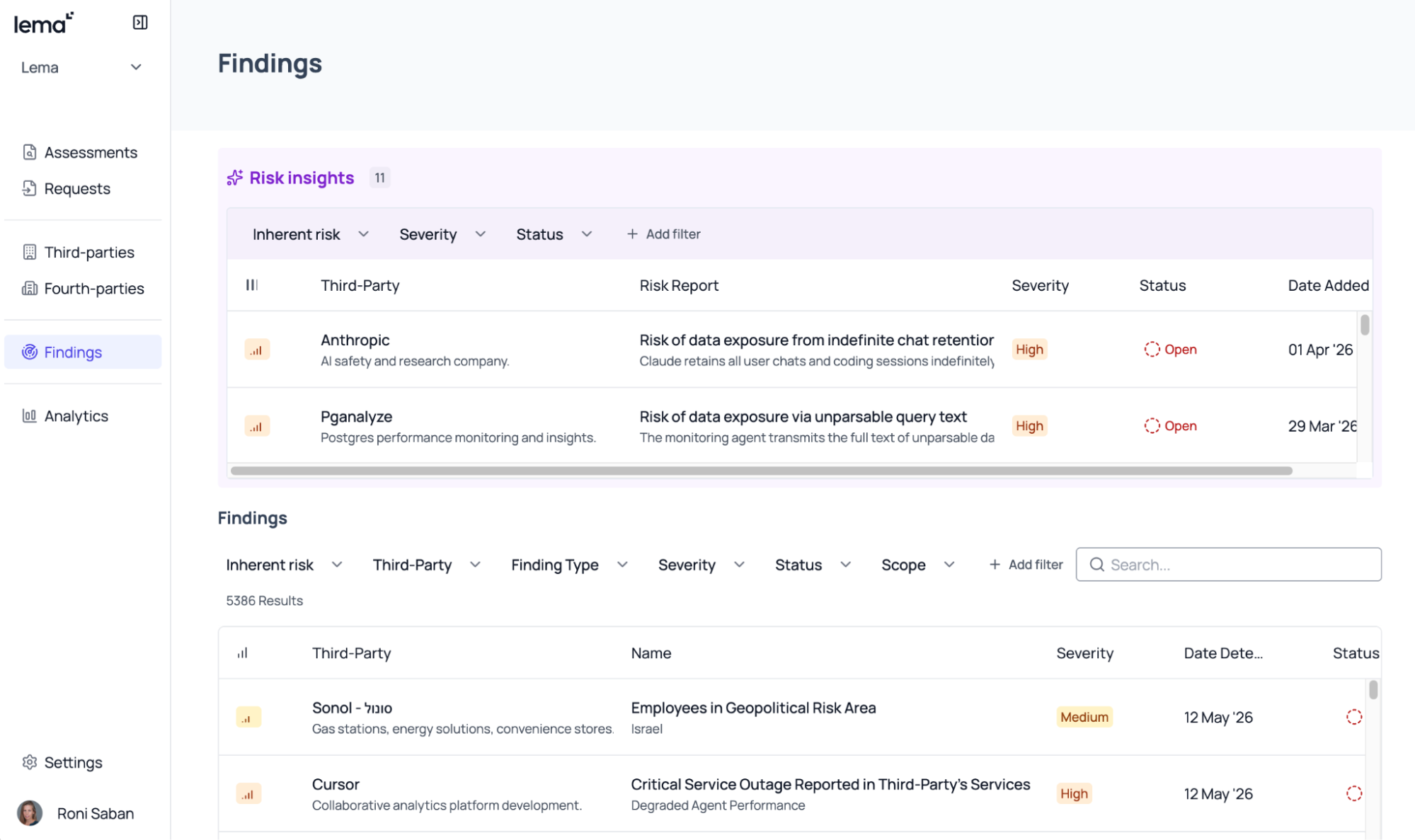
Lema is an Agentic TPRM and Risk Engineering platform that helps uncover, reduce, and prevent real third-party exposure. It uses Forensic AI Assessment and OSINT Recon to analyze vendor artifacts, validate controls, and continuously collect external intelligence.
Then, with Blast Radius Mapping, it tracks how vendors are actually used across your environment, including their access, data exposure, business dependency, and scope of use. This allows Lema to derive inherent risk independently from real usage signals, rather than relying only on business-owner input or point-in-time assessment assumptions. It can identify where a vendor’s role has expanded beyond the original approved scope, where exposure is greater than expected, or where a third party has access to sensitive systems that materially change its risk profile.
These signals are correlated by Agentic Risk Engineering, which surfaces prioritized, evidence-backed risks with precise remediation steps. The result is a platform that gives teams a clear, actionable understanding of where they are exposed and how to reduce that risk. Lema is not designed for organizations whose primary need is audit evidence collection or compliance certification workflows.
Best for: TPRM, s ecurity, and risk teams that want to reduce vendor exposure rather than actively manage assessments.
2. Panorays
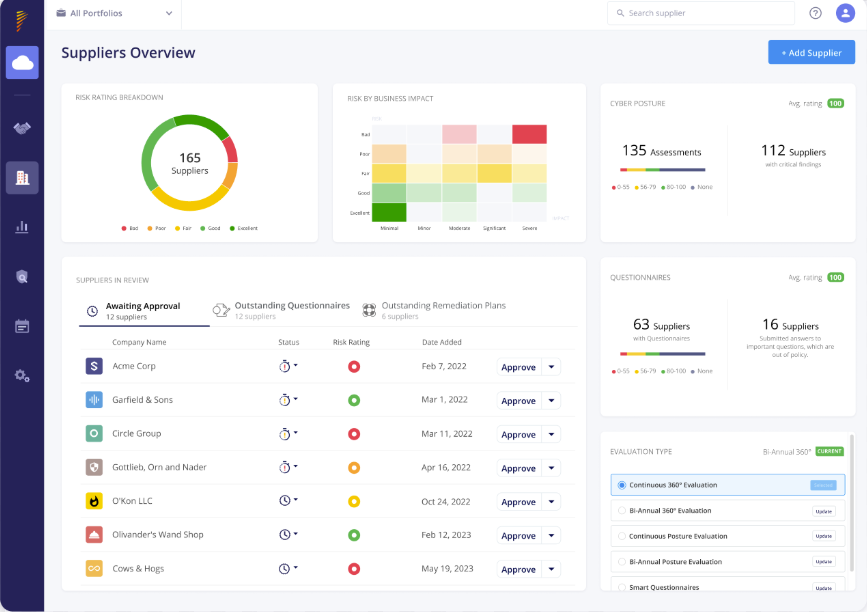
Panorays combines automated vendor assessments with continuous external monitoring. Its core capability is its Automated Security Questionnaires, which use adaptive logic to tailor assessments based on vendor risk profiles. These questionnaires are paired with Evidence Collection and Validation, allowing vendors to submit documentation that is mapped against control requirements and tracked centrally.
What differentiates Panorays from pure workflow tools is its External Attack Surface Monitoring, which continuously scans vendor assets for vulnerabilities. Meanwhile, Cyber Risk Rating and Risk Insights provide a continuously updated view of vendor posture. While Panorays improves both efficiency and vi sibility, its analysis still relies on a combination of scoring models and vendor inputs, without deeply correlating findings to internal usage or blast radius exposure.
Best for: Organizations that want a balance between automated assessments and continuous monitoring of external vendors.
“The most helpful aspect of Panorays is how it simplifies and centralizes third-party cyber risk management. It gives security and risk teams a clear, structured view of vendor risk by combining automated security ratings and continuous monitoring in one platform.”
Compliance and Trust Management Platforms
These platforms focus on standardizing compliance processes and automating audit readiness. TPRM is typically one component within a broader trust or compliance framework. While they provide strong workflow automation and reporting, they often lack AI strategic visibility into how vendor risk translates into real business exposure. These tools are optimized for efficiency and consistency, not deep risk analysis.
3. Vanta
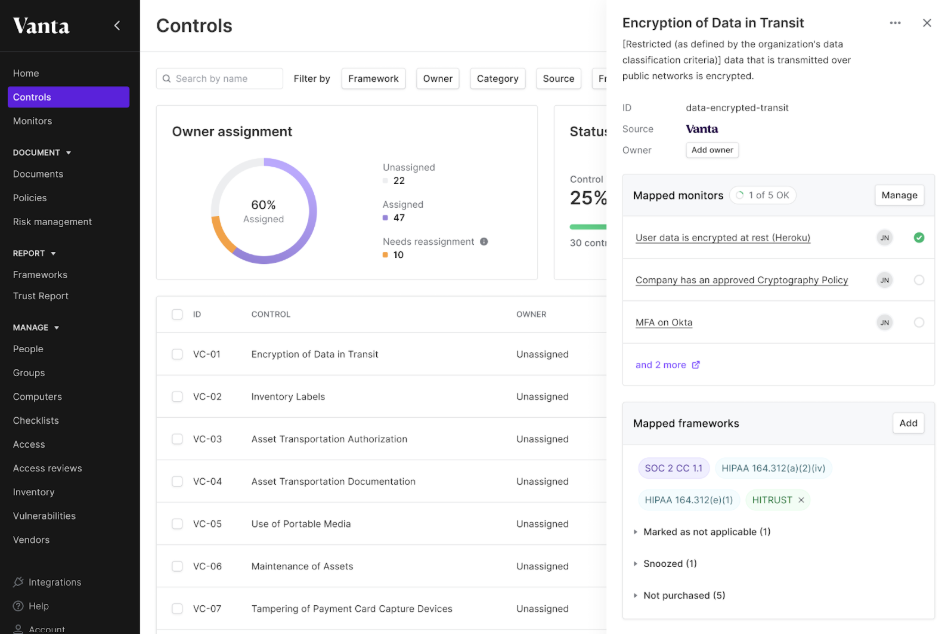
Vanta is a compliance automation platform built to help companies achieve and maintain certifications such as SOC 2, ISO 27001, and HIPAA, with TPRM integrated into its broader trust management functionality. Its core strength lies in continuous evidence collection through deep integrations with cloud infrastructure, identity providers, version control systems, and endpoint security tools. These integrations allow Vanta to automatically monitor control states and flag deviations without requiring manual evidence uploads.
However, vendor risk management remains largely dependent on structured inputs and predefined frameworks. The platform does not deeply analyze vendor artifacts or correlate external signals with internal exposure.
Best for: Companies prioritizing fast, scalable compliance and audit readiness, especially startups and mid-market teams.
“Overall, my experience with Vanta has been positive! Vanta helps me develop ISO compliance work with clarity and structure. Having all the controls and evidence in one place makes the work efficient, reducing my mental load and the uncertainty.”
4. Drata
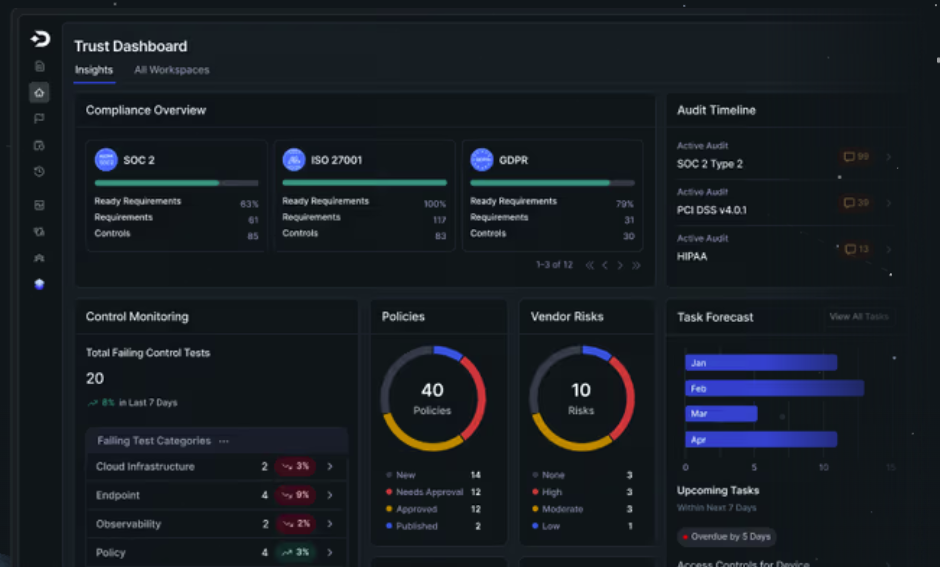
Drata focuses on continuous compliance automation, with an architecture similar to Vanta's but more heavily focused on audit workflows and control monitoring. It integrates with cloud infrastructure, HR systems, identity providers, and developer tools to automatically collect and validate evidence across security and compliance controls. Its TPRM capabilities include vendor inventory tracking, risk tiering, due diligence workflows, and document management. There is no deep inspection of vendor artifacts beyond collection, and limited correlation between vendor risk and actual business usage or system access.
Best for: Organizations that need continuous audit readiness and want to reduce the operational burden of maintaining compliance certifications.
“What I like about Drata is how it transforms compliance from a manual, point-in-time effort into a continuous, automated process. Its integrations with tools like cloud providers and identity systems make evidence collection largely hands-off.”
5. OneTrust Third-Party Risk Management
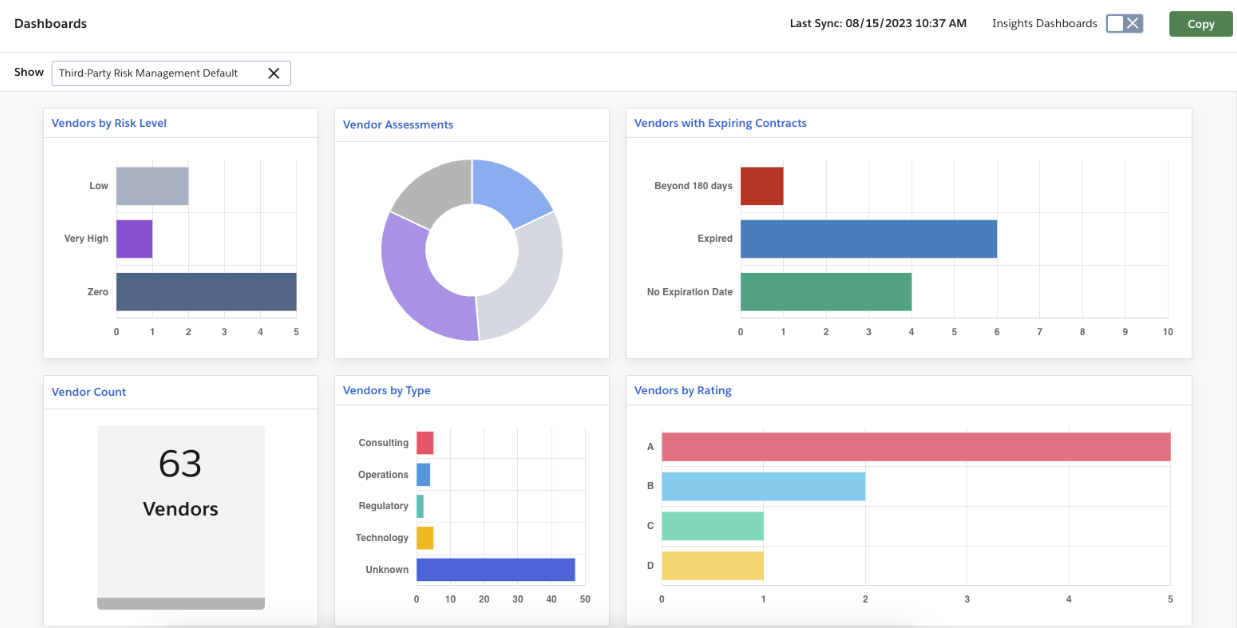
OneTrust provides a comprehensive enterprise-grade TPRM solution as part of its broader governance, risk, and privacy platform. It covers the full vendor lifecycle, including onboarding, inherent risk assessment, due diligence, contract management, and ongoing monitoring. The platform supports highly configurable workflows, allowing organizations to design complex approval chains, automate assessment distribution, and enforce policy-driven decision-making across global vendor ecosystems.
Its risk analysis is largely driven by scoring models and vendor-submitted responses, with limited ability to validate claims or connect findings to real operational exposure independently.
Best for: Large enterprises that need structured, policy-driven TPRM with strong governance and regulatory alignment.
“This product is a great addition to our CyberSecurity department. It is much better than the previous GRC tool we implemented. The risk assessments are easy to configure, and the reporting and automation are user-friendly.”
6. Hyperproof
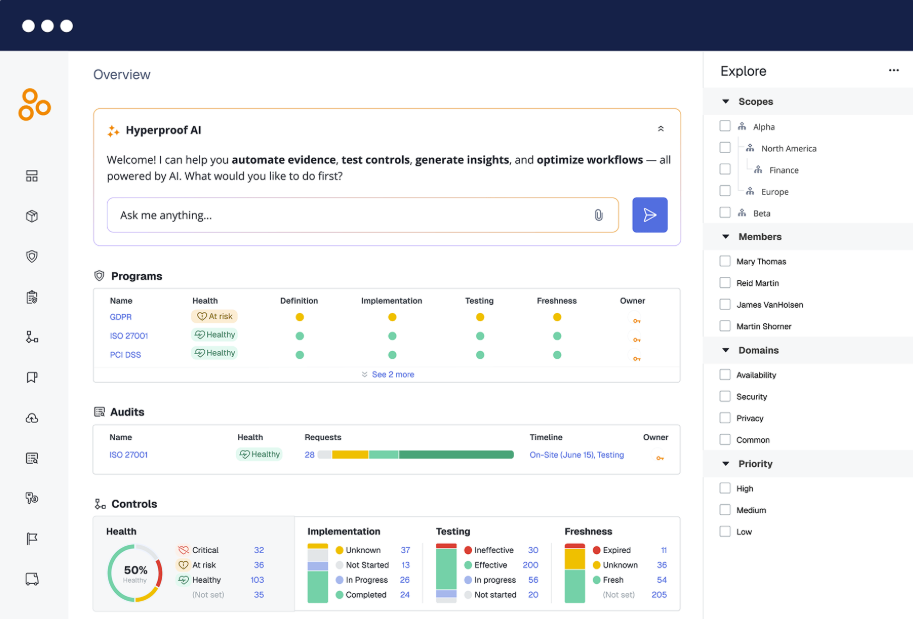
Hyperproof operationalizes compliance and risk management workflows across organizations, with a strong emphasis on collaboration, task management, and audit readiness. It provides a centralized platform for managing controls, evidence, and risk activities, integrating with tools like Jira, Slack, and cloud services to streamline how teams collect and manage compliance data.
Its TPRM functionality includes vendor inventory management, risk assessments, and workflow automation for due diligence processes. However, like other compliance-first platforms, Hyperproof relies heavily on structured data inputs and does not perform deep analysis of vendor artifacts or external intelligence.
Best for: Organizations that need to coordinate compliance operations across multiple teams and frameworks with strong workflow visibility.
Enterprise GRC & Risk Platforms
GRC software solutions for enterprises provide broad governance, risk, and compliance capabilities, with TPRM as one module within a larger system. They are ideal for scale and flexibility across enterprise risk programs. Look for configurable workflows, robust reporting, integration capabilities, and alignment with broader risk management strategies.
7. Archer
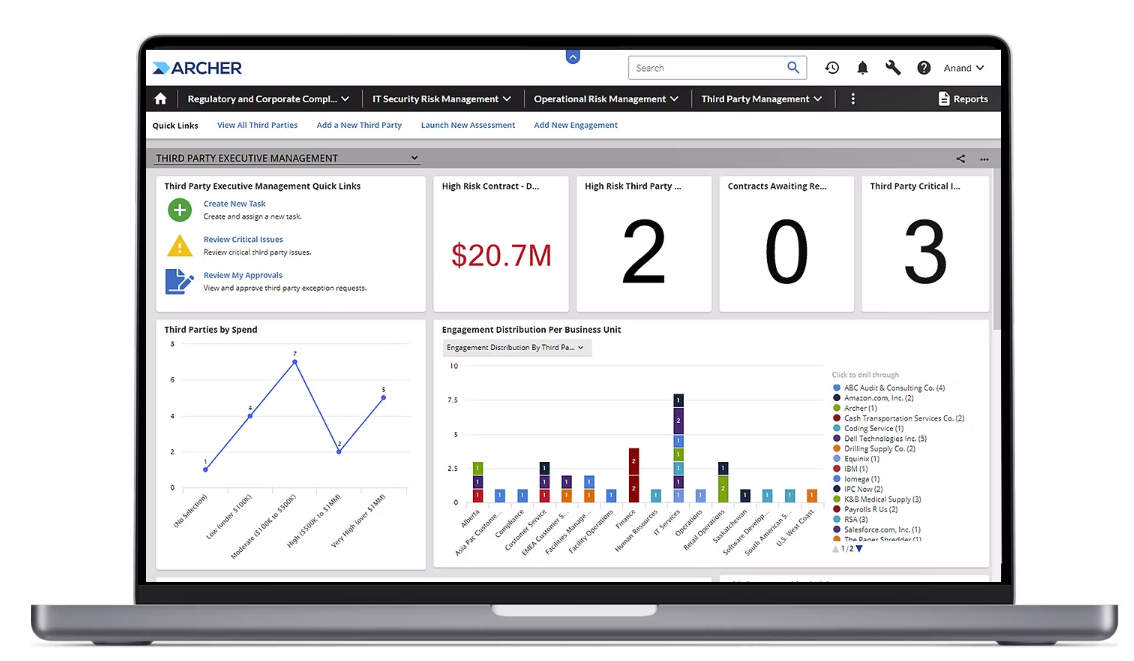
Archer is a long-standing enterprise GRC platform that provides extensive capabilities across risk management, compliance, audit, and TPRM. Its third-party risk module supports vendor onboarding, risk assessments, issue management, and ongoing monitoring, all within a highly configurable framework that can be tailored to complex organizational requirements.
The platform supports large-scale vendor inventories, advanced reporting, and regulatory alignment across multiple jurisdictions. Archer’s flexibility comes with complexity. Implementing and maintaining the platform often requires dedicated resources, and its risk analysis remains dependent on predefined models and structured inputs.
Best for: Large enterprises with mature GRC programs that require deep customization and integration across risk domains.
“Great dashboards that showcase operational risk and eGRC capabilities. It helps with the high-level overview of RCSA results and statuses within our organization.”
8. LogicGate Risk Cloud
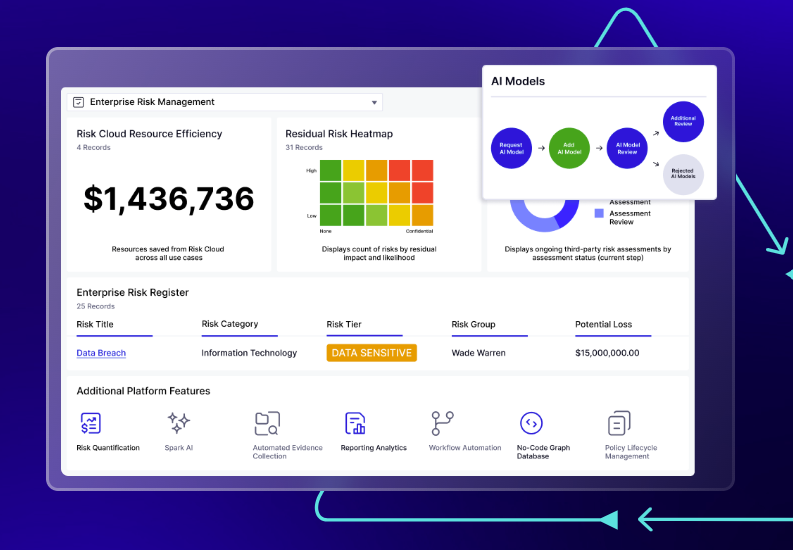
LogicGate Risk Cloud is a highly configurable platform that allows organizations to build custom risk and compliance workflows, including TPRM processes, using a no-code interface. It enables teams to design vendor onboarding flows, supplier risk assessments , approval processes, and remediation tracking without relying on rigid templates.
The platform supports centralized vendor inventories, risk scoring, and issue management, with integration capabilities that allow data to flow between systems such as procurement tools, ticketing platforms, and cloud infrastructure. Its flexibility makes it suitable for organizations with unique or evolving requirements, but it also means that much of the functionality must be built and configured internally.
Best for: Organizations that want full control over how their TPRM workflows are designed and executed.
“I like LogicGate Risk Cloud because it allows me to manage risks, compliance, and audits all in one place. The software eliminates manual, spreadsheet-based GRC work through automated workflows, which helps reduce audit delays and spares me a lot of time.“
9. Certa AI
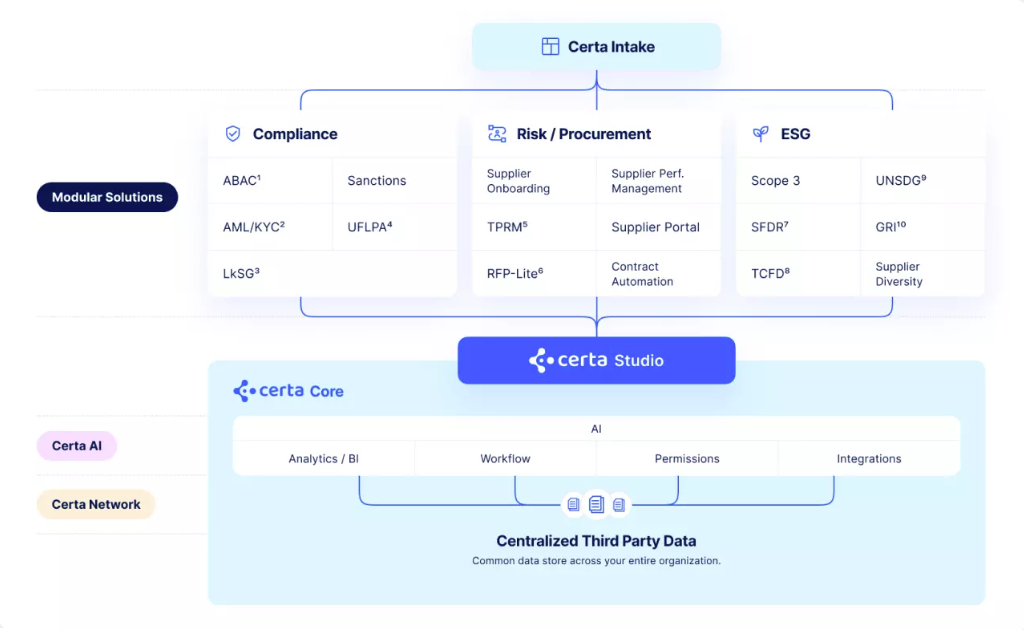
Certa AI connects procurement, onboarding, and risk workflows into a single system. Its core capability is Third-Party Lifecycle Management, using Configurable Intake Workflows to route vendors through risk-based approvals and Dynamic Risk Scoring to classify them based on factors such as data access, geography, and service type.
It includes Document and Evidence Management for collecting certifications and contracts, along with Third-Party Monitoring Data Feeds and Supplier Dependency Tracking to surface concentration and fourth-party risk. Certa’s analysis is still driven by structured inputs and external data, without deep artifact analysis or internal exposure mapping.
Best for: Organizations that need to unify procurement and third-party risk workflows at scale.
“ The team is incredibly dedicated and focused on meeting the project's objectives, both in terms of substantive delivery and hitting milestones according to set timelines.”
10. Optro AI
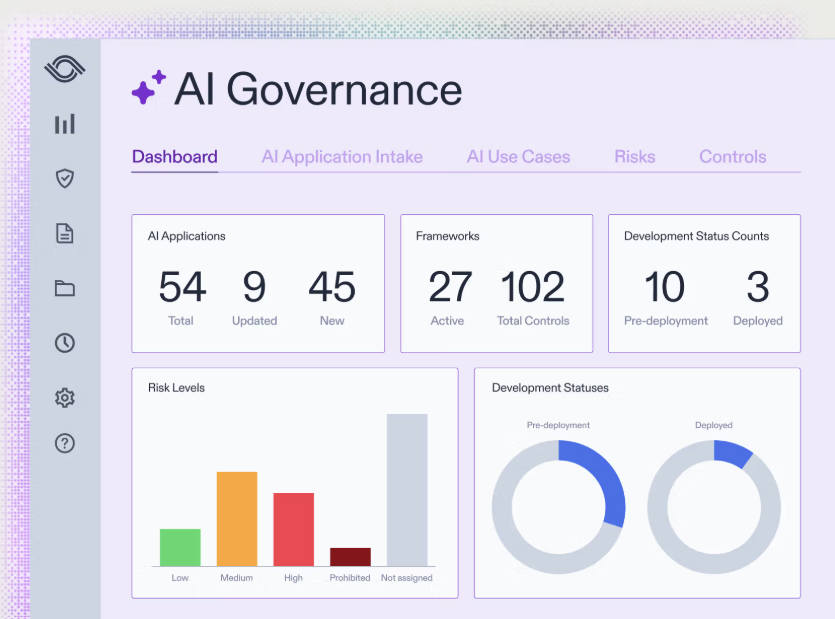
Optro AI applies machine learning to analyze vendor questionnaires and supporting documents, extracting relevant control information and identifying gaps. The platform is built to standardize and accelerate assessment workflows, helping teams map vendor responses to internal requirements and streamline follow-ups across large volumes of vendors.
However, its capabilities appear centered on assessment automation rather than independent risk validation. It relies on vendor-submitted data and does not provide deep external intelligence or visibility.
Best for: Teams looking to automate manual questionnaire review and scale assessment workflows efficiently.
“The way Optro surfaces relevant tools and integrations based on actual workflow context rather than generic category browsing has changed how our team approaches finding new solutions.”
External Risk Intelligence & Ratings Platforms
These tools focus on analyzing vendors externally, using scanning and threat intelligence to assess security posture. They are useful for continuous monitoring and benchmarking, but often lack internal context. Look for strong data collection and transparent scoring models, as well as the ability to track changes over time.
11. SecurityScorecard
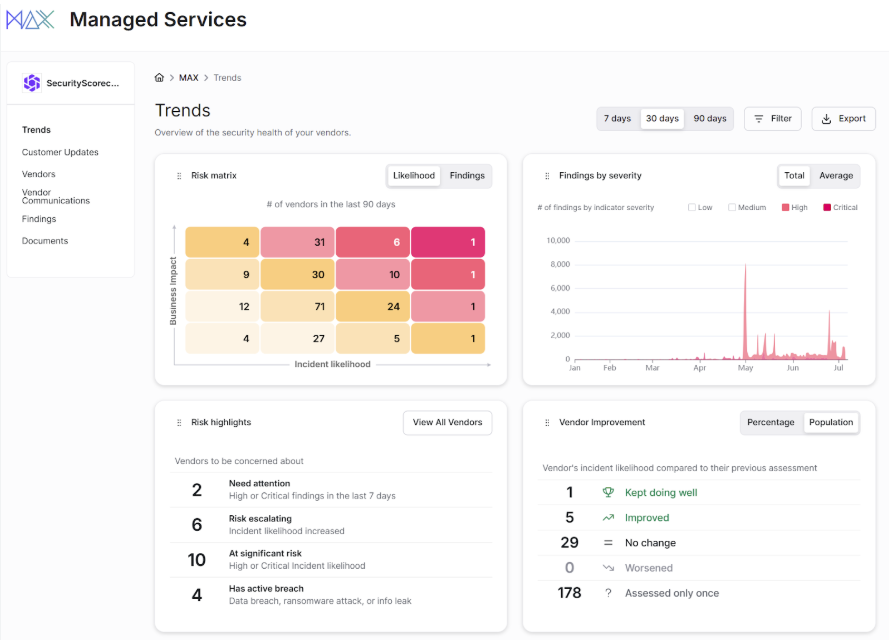
SecurityScorecard’s core capability is its Security Ratings, which assign vendors a letter grade (A–F) based on data collected from internet-facing assets. These ratings are broken down into 10 defined Risk Factors, including Network Security, DNS Health, Endpoint Security, Patching Cadence, and Application Security. The platform also offers Atlas, its built-in evidence exchange and questionnaire workflow system, allowing organizations to request documentation and share security data within the platform.
While SecurityScorecard provides strong benchmarking and external visibility, its analysis is limited to observable signals and vendor inputs, without connecting findings to internal usage or business impact.
Best for: Teams that need scalable vendor benchmarking, continuous monitoring, and a standardized way to compare third-party security posture.
“Connecting our score to the fullest third-party security risk exposure view. One of the things that I found most amazing was just how much you can see about a vendor's security posture and not get bogged down in the weeds of all the technical analysis.”
12. BitSight
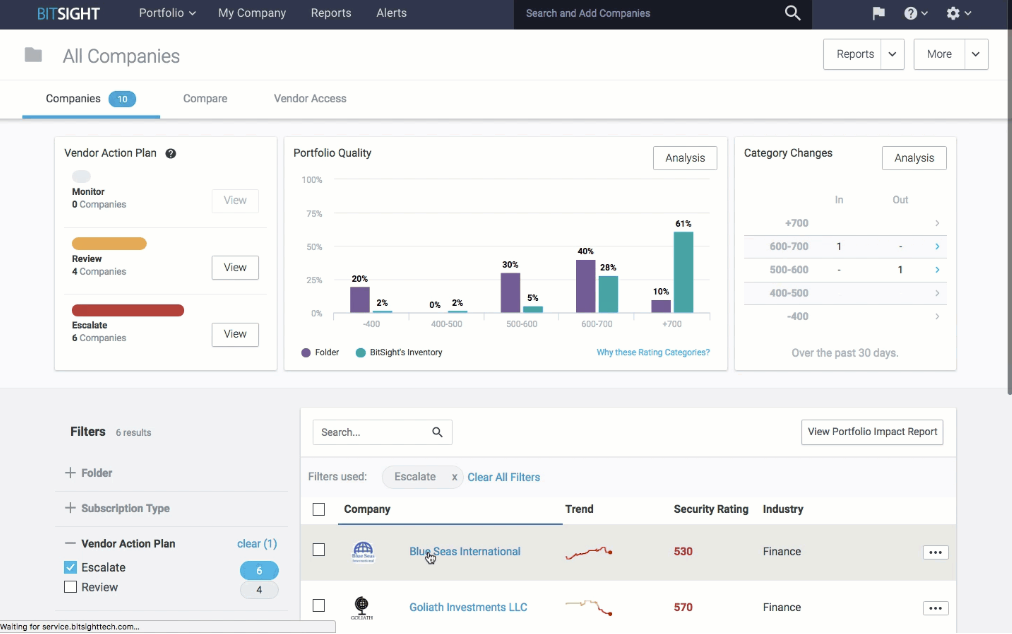
BitSight provides continuous visibility into third-party security performance using externally observable data. Its core capability is the BitSight Security Rating, a numeric score (250–900) derived from telemetry such as internet-wide scanning, botnet activity, malware infections, and observed vulnerabilities.
The platform offers Continuous Monitoring, tracking changes in vendor posture over time, and Vendor Risk Management capabilities, allowing organizations to build vendor portfolios, assign risk tiers, and track remediation efforts. While BitSight delivers strong external telemetry and historical benchmarking, it does not analyze vendor artifacts or connect findings to internal system access.
Best for: Organizations that want mature security ratings, continuous monitoring, and historical benchmarking across large vendor ecosystems.
“What I like best about BitSight is that it gives companies a simple daily 'security score' like a credit score for cyber risk. It watches your own systems and your vendors from the outside without bothering anyone, spotting problems early.”
How We Compared These Tools
We compared these tools using consistent, verifiable criteria to help you make a realistic shortlist. This evaluation is based on publicly available information as of 2026, including official product documentation, feature pages, release notes, and credible third-party reviews.
We reviewed vendor documentation, platform capabilities, integration depth, and how each tool actually handles vendor data, risk analysis, and monitoring. We also cross-referenced claims with independent sources to avoid relying purely on vendor positioning.
From Checking Boxes to Finding Risk
Choosing the right TPRM platform depends on what you're actually trying to solve. Some are built to streamline compliance. Others manage workflows at scale or give you external visibility into vendor posture. All of them are useful, but they're solving different problems.
The bigger shift in this category is the move from process to exposure. Knowing that a vendor passed an assessment or has a good security rating isn't enough on its own. You also need to know how that vendor connects to your environment, and what's actually at risk if something goes wrong.
Lema is built for that. Forensic AI Assessment analyzes vendor artifacts and validates the controls behind their claims. OSINT Recon continuously collects external intelligence on every vendor. Blast Radius Monitoring maps vendor access to how each vendor is actually used in your environment. Agentic Risk Engineering correlates all of it and surfaces prioritized, evidence-backed findings with clear remediation steps.
Instead of vendor-submitted information taken at face value, you get real risk and a path to fix it.

FAQs
What Is TPRM (Third-Party Risk Management)?
Third-party risk management (TPRM) is the process of identifying, assessing, and managing the risks introduced by external vendors, suppliers, and partners. These risks can include security vulnerabilities, data exposure, compliance failures, and operational disruptions. TPRM ensures that organizations understand how third parties interact with their systems and data, and that appropriate controls are in place to reduce potential impact.
What Are the 5 Phases of Third-Party Risk Management?
The five phases of TPRM typically include vendor onboarding and risk identification, where vendors are scoped and classified; risk assessment, where documentation and controls are reviewed; due diligence and validation, where findings are verified and gaps addressed; ongoing monitoring, where vendor risk is tracked over time; and offboarding, where you remove access, and residual risks are managed when the relationship ends.
How to Do Third-Party Risk Management?
Effective TPRM starts with building a complete vendor inventory and understanding how each vendor is used across the organization. From there, vendors are classified based on risk, assessed using a combination of documentation and independent signals, and continuously monitored for changes in posture or usage. The goal is not just to complete assessments, but to connect vendor risk to real business exposure and take action.
What Are the Four Core Third-Party Risk Types?
The four core third-party risk types are security risk (cyber threats and data breaches), compliance risk (failure to meet regulatory or legal requirements), operational risk (disruptions to business processes or services), and reputational risk (damage to brand or trust due to vendor actions or incidents). Each type reflects a different way a third party can impact the organization.
