
TPRM Software: A Modern Buyer’s Guide

The third-party attack surface is now the fastest-growing risk vector in enterprise security. The 2026 Verizon Data Breach Investigations Report found that 48% of all confirmed breaches involved a third party, a 60% year-over-year increase and a threefold rise since the metric was first tracked in 2024. Despite this, most organizations still manage vendor risk with static questionnaires, annual review cycles, and spreadsheets that start getting outdated the moment they are saved.
The third-party risk management (TPRM) software market has responded with volume rather than substance. Hundreds of tools now compete for attention, but most optimize for audit readiness rather than for security controls. They produce reports and dashboards while ticking regulatory boxes, but they fail to catch the risks that open the door to breaches, such as silent permission escalation, scoped-out SOC 2 reports, or shadow sub-processors in a restricted jurisdiction.
This article defines the six critical features any TPRM platform must deliver to genuinely protect an organization against third-party risk. It includes a technical breakdown of the functionality behind each capability and an honest assessment of why achieving it is harder than most vendors admit.
Summary of must-have TPRM software features
The following table summarizes the essential features and functionalities covered in this article that readers should expect from their tools in the AI era.
{{banner-large-1="/inline-cards"}}
AI-powered forensic assessments
A SOC 2 Type II report sits in your evidence repository. It looks complete because the auditor issued an unqualified opinion, and the vendor passed. But buried on page 47, the scope statement excludes “platform services,” which is the exact product your engineering team deployed last quarter. Your actual coverage was zero.
This is the gap that forensic assessment closes. AI-powered forensic assessment means that the software does not summarize vendor documents; it investigates them instead. It cross-references claims across SOC 2 reports, penetration test results, data processing agreements, privacy policies, and questionnaire responses to surface contradictions, gaps, and hidden risks that human reviewers miss under volume fatigue.
Manual reviews consume 40-60 analyst hours per vendor. With portfolios exceeding 500 vendors, backlogs form, onboarding stalls, and risk teams become the bottleneck to every business initiative. The goal is vendor assessment in minutes, not weeks, while catching risks that fatigue-driven human review routinely overlooks.
In practice, vendor artifacts span thousands of pages across document types that require fundamentally different interpretation skills: legal language in DPAs, technical controls in pen test reports, and compliance attestations in SOC 2s. Also, evidence quality varies wildly, from vendors providing comprehensive documentation to those returning single-word questionnaire answers. The same control gap might be critical for a financial services customer but irrelevant for a marketing use case. And context shifts over time as the vendor's product version changes, the audit scope narrows, or your own usage expands into areas the certification never covered.
The following diagram illustrates how Lema addresses this complexity. By correlating its Forensic AI Assessment findings with intelligence gathered through OSINT Recon and your approved scope, Lema systematically separates what a vendor claims from what the evidence demonstrates, and maps both against your control framework. The outputs, such as the cited control gaps, targeted questions for the vendor, and a verifiable due diligence trail, replace the manual effort of hunting through thousands of pages with an auditable, repeatable process.
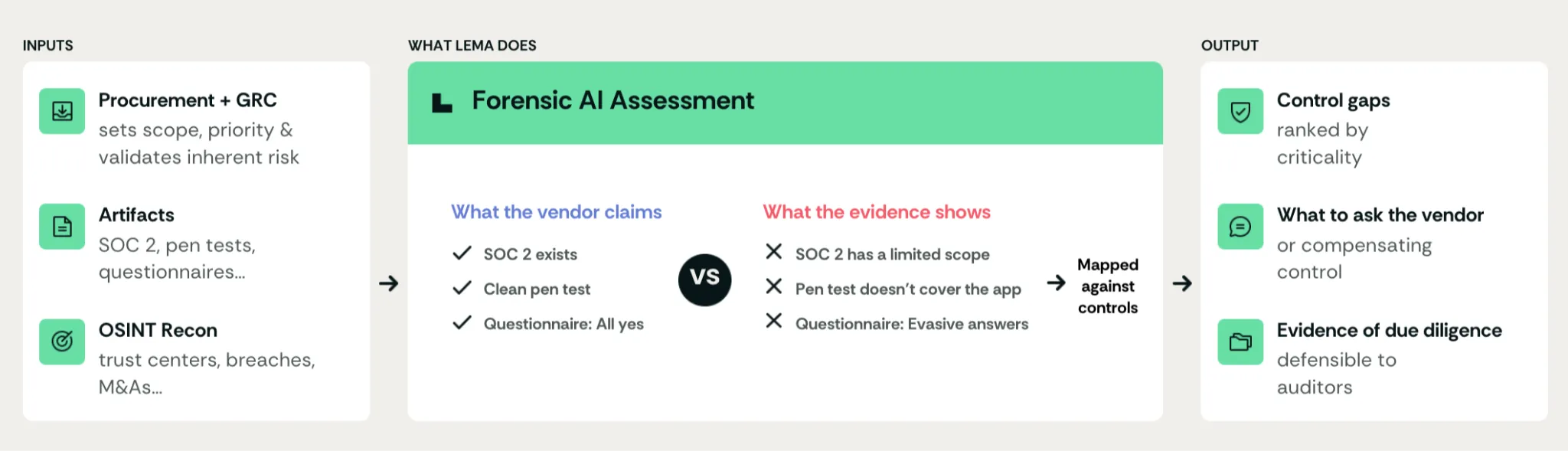
Most current TPRM software products fall short here. Legacy GRC tools collect self-reported questionnaire answers but never validate them against submitted evidence; they record what the vendor says, not what the evidence proves. AI-wrapper summarizers (thin GPT layers) produce document summaries but perform no cross-examination across artifacts, hallucinating confidence when the document they read describes a different product entirely. Security ratings platforms provide an outside-in score based on external scanning but cannot read a single internal vendor document. None of these produce findings that are cited, backed by specific document, page, and clause references that an auditor or regulator can independently verify.
Effective forensic assessment by TPRM software should operate like a vulnerability researcher, not an auditor. The system must reason across 20-50 interconnected artifacts per vendor, resolve cross-document dependencies, and apply adversarial logic to hunt for inconsistencies between high-level policies and technical documentation.
Here are some of the key capabilities of a forensic assessment engine:
- Cross-document reasoning: Correlating claims in questionnaire responses against evidence in SOC 2 reports, pen tests, and DPAs simultaneously
- Scope validation: Automatically verifying that certifications and audit reports actually cover the specific product/service in use
- Cited findings: Ensuring that every output is constrained to reference the exact source text (document, page, clause) supporting the finding
- Custom control frameworks: Controls definable in natural language, applying the organization's actual risk tolerance rather than generic industry defaults
Continuous monitoring of access paths and blast radius
Consider a scenario that most security teams will recognize: Your company approved a project management SaaS tool 18 months ago. At onboarding, it had read access to a single Jira project. Since then, a well-meaning IT administrator granted OAuth access to the organization's Google Workspace to enable a calendar sync feature. Nobody in the security team was notified. The vendor now has read access to every employee's email metadata, calendar entries, and shared drives, while the original risk assessment says “Low: project tracking only.”
Continuous monitoring of access paths means tracking, in real time, the actual permissions, data flows, and system connections between your environment and every third party. Not what was approved at onboarding but what exists right now. Blast radius quantifies the downstream impact: If this vendor is breached today, what data is exposed, which systems are affected, and how far does damage cascade through interconnected services?
The challenge extends beyond what procurement tracks. Shadow IT (applications adopted by employees without security review) poses a risk that no intake form can capture. Research from Grip Security estimates that the average enterprise has three to five times as many SaaS applications in active use as IT is aware of.
Blast radius calculation requires correlating multiple data layers that typically live in separate tools managed by separate teams, as shown in the table below.
Traditional TPRM software operates in a point-in-time manner: Assess at onboarding, file the report, and remain blind until the next annual review cycle. Security rating platforms monitor the vendor's external perimeter, not the internal connection to that vendor’s platform. They can tell you, for example, that a vendor's SSL configuration changed, but they often fail to tell you that the same vendor now has write access to your production S3 buckets. Most continuous monitoring offerings in TPRM simply refresh an external score weekly or monthly, but that is just monitoring the vendor's hygiene, not your exposure.
Effective continuous monitoring by TPRM software should fuse three high-level intelligence layers into a single operational picture:
- Layer 1 (native intelligence) monitors vendor-side changes, such as documentation updates and sub-processor lists.
- Layer 2 (security stack integration) pulls live technical signals from IdP, CASB, CSPM, and EDR tools.
- Layer 3 (business context) ingests contractual and procurement data that reflects intended usage.
All three layers flow downward into a correlation engine that cross-references legal scope against technical reality and triggers automated reassessment when conflicts are detected, as shown below.
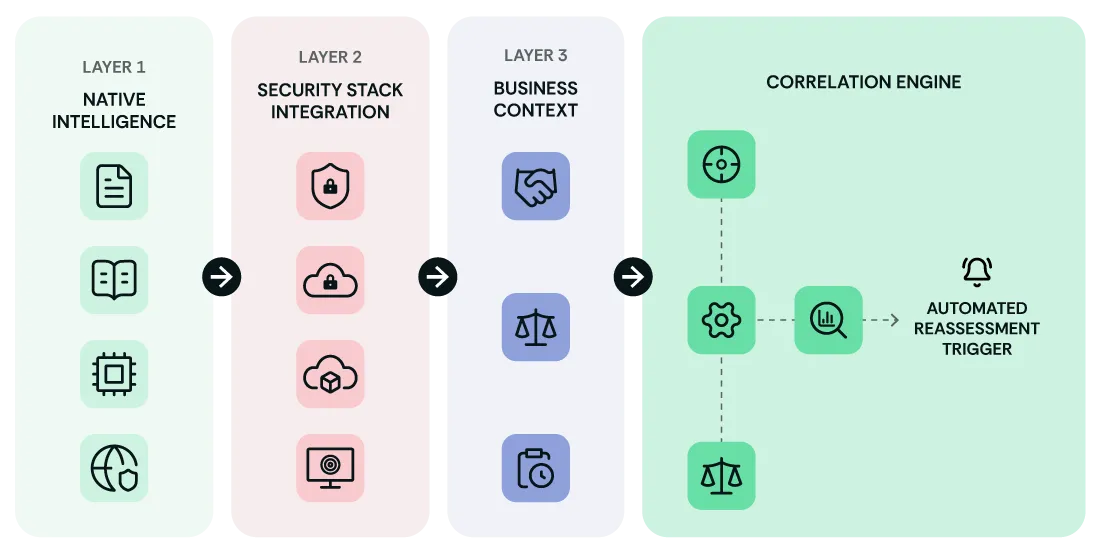
TPRM software should operate as a continuous loop, not an on-demand scan. Any environmental change (e.g., a new OAuth grant, permission escalation, or vendor adding an AI feature that processes customer data) should automatically trigger reassessment. The system should detect scope drift the moment it occurs, identify shadow IT that bypassed procurement, flag stale vendors still holding active credentials, and map the live blast radius. In this way, it can distinguish between harmless read-only connections and active, high-privilege access to “crown jewels.”
{{banner-small-1="/inline-cards"}}
Automated compliance reporting
Audit season arrives, and the compliance team needs to demonstrate that the organization exercises continuous oversight over third-party ICT risk, a requirement under DORA Article 28, NIS2 Article 21, and multiple provisions of SOC 2's Trust Services Criteria. The TPRM team has done the work: Vendors were assessed, gaps identified, and remediation tracked. But proving that to an auditor requires extracting data from six different systems, manually cross-referencing findings against framework controls, and assembling evidence packages in a format regulators accept. This takes weeks of time every year.
Automated compliance reporting means that vendor risk findings automatically map to regulatory and framework requirements, producing audit-ready documentation as a byproduct of ongoing risk management rather than a separate, labor-intensive exercise. Unfortunately, legacy GRC platforms produce compliance reports that reflect questionnaire answers rather than validated evidence. When an auditor is asking how you know a control is implemented, the answer cannot be that the vendor said so. Security ratings provide a score but no framework mapping, e.g., a “B” rating tells a DORA auditor nothing about Article 28 compliance.
Most critically, regulations like DORA and NIS2 require demonstrating continuous oversight, not annual questionnaires. Point-in-time assessment tools cannot, by their nature, satisfy this requirement, regardless of the quality of their reporting layers.
The right TPRM software solution is not to build a better reporting module on top of a broken assessment process but to make compliance evidence a natural by-product of how assessments are conducted in the first place. When every vendor finding is produced with cited sources (specific document, page, and clause), mapped to the relevant framework controls (SOC 2, ISO 27001, GDPR, or DORA) at the time of discovery, and timestamped in a living audit trail, compliance reporting stops being a separate exercise. The organization can demonstrate at any point what it knew about a vendor's posture, when it learned it, and what actions were taken.
Board reporting, operational dashboards, and audit evidence packages are all generated from the same underlying data, ensuring consistency among stakeholders without manual reconciliation. This is the defensibility standard that regulators expect in post-breach inquiries, and it is only achievable when the assessment engine itself produces framework-mapped, cited output as its native format rather than as an afterthought bolted onto questionnaire responses.
Dynamic risk tiering and contextual scoring
A Fortune 500 company classifies a PDF conversion tool as “Tier 3, Low Risk.” The intake form confirms no sensitive data processing, no PII handling—utility function only. What the intake form doesn't capture is that the IT team granted the tool OAuth permissions to read and delete files across the entire corporate Google Drive to enable its “batch conversion” feature. The tool has admin-equivalent access to legal documents, board materials, and M&A filings.
This failure mode is endemic in TPRM programs that rely on static tiering: Classification is assigned at onboarding based on self-reported intake forms and is never updated. Dynamic risk tiering continuously reclassifies vendors based on objective signals: actual permissions held, data sensitivity accessed, and real business criticality. Contextual scoring ensures that the risk score reflects your specific exposure, not a generic industry benchmark that's identical regardless of who's asking.
The fundamental failure is a disconnect between who classifies risk and who grants permissions. Risk tiering must be dynamic because vendor relationships evolve: A vendor classified as “low” at onboarding could become “critical” after gaining integrations, processing more sensitive data, or introducing AI features that ingest customer content. Generic risk scores from external ratings platforms compound the problem by producing a universal number that's identical for every customer regardless of actual deployment, permissions, or data flows.
Effective dynamic tiering evaluates risk using objective signals rather than business-owner assumptions, and it operates in two modes:
- Pre-integration (inherent risk estimation): Before any technical integration exists, the system derives inherent risk by analyzing the vendor's capabilities and published data handling practices, typical integration patterns, and historical breach data for similar services. This catches the “low-risk” sales tool that demands high-risk permissions before it's approved.
- Post-integration (live contextual risk): Once security stack integrations provide real data, risk classification should update automatically. The system tracks actual OAuth/API permissions held (not what was contracted), the volume and sensitivity of data flowing to the vendor, the number and criticality of systems the vendor can reach, and whether observed access exceeds contractual scope. It also factors in changes to the vendor's own risk profile, such as a disclosed breach, an acquisition, or security team restructuring. Any of these shifts should trigger reclassification without waiting for a human to initiate a review cycle.
Sophisticated TPRM software should be able to assess the risk in advance. For example, in the screenshot below, Lema (an agentic third-party exposure management tool) predicts the real impact before onboarding to catch the “low-risk” sales tool that demands high-risk access. We will use other screenshots from Lema’s platform in later sections.
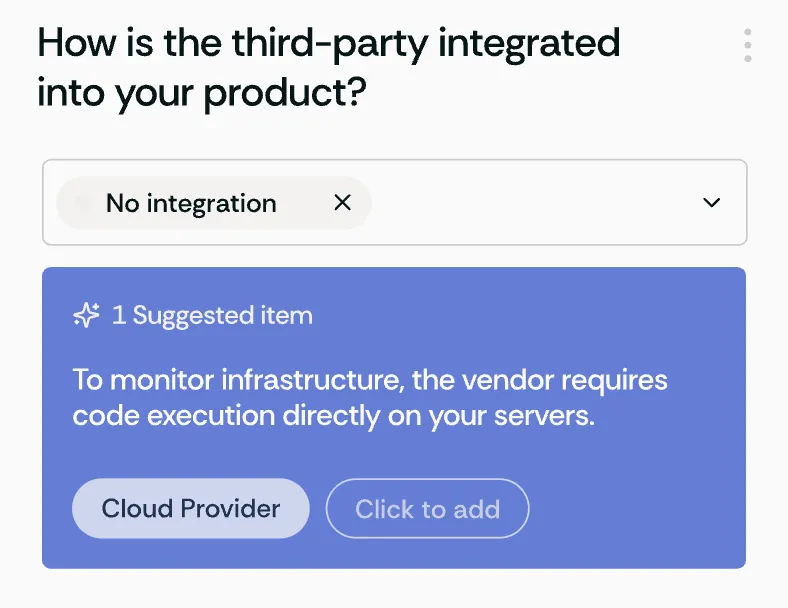
The same third-party vendor can legitimately receive different risk scores at different organizations. For example, a CRM that touches only marketing leads at Company A but has access to financial records and SSNs at Company B represents fundamentally different risk levels, and the scoring must reflect this reality.
{{banner-small-2="/inline-cards"}}
Vendor posture management and gap analysis
Three months after completing a thorough assessment of a cloud infrastructure vendor, your team discovers, via a dark web monitoring alert, that the vendor suffered a breach affecting its authentication service. The assessment, which rated their identity controls as “Strong,” is now meaningless. Worse, it's actively misleading because your organization is operating on confidence that no longer reflects reality, and no one on the risk team knows that the assessment is stale until the breach makes headlines.
Vendor posture management is the continuous practice of tracking each vendor's security posture and identifying gaps between claims and evidence. It is not an assessment but rather an ongoing assurance function that treats vendor security as a living, degrading quantity instead of a point-in-time grade that remains valid indefinitely.
Vendors present an optimized view of their security posture. Trust center pages are marketing documents. Questionnaire responses are aspirational. SOC 2 reports are backward-looking and scope-limited. The gap between what a vendor claims and what evidence supports grows every day after assessment, and detecting that gap requires adversarial investigation across multiple sources.
The right TPRM solution should apply adversarial inference to every vendor's stated posture. It actively hunts for inconsistencies the way a penetration tester hunts for vulnerabilities:
- Cross-source validation: Comparing marketing language against technical documentation, privacy policies against observed data flows, and certification scope against actual product coverage.
- Continuous OSINT integration: Tracking signals that the vendor won't disclose proactively, like breach disclosures, dark web exposure, security team departures, M&A activity, and regulatory enforcement actions. Each signal is correlated with your specific engagement to determine materiality—a vendor breach in a product you don't use is noise; in the product you depend on, it's critical.
- Drift detection: Any vendor re-enters the assessment loop when material changes are detected, such as a new sub-processor, policy revision, breach disclosure, certification expiration, or leadership change in the security function.
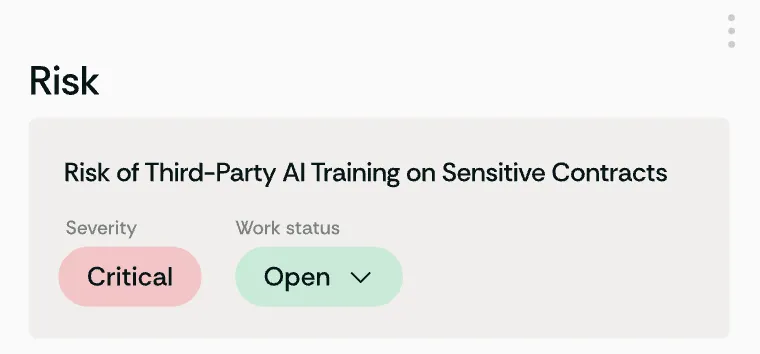
The platform must surface the delta between what was assessed and what has changed, maintaining a continuous view of posture degradation rather than a binary assessed/not-assessed state.
Intelligent evidence collection and smart vendor engagement
The average enterprise TPRM program sends the same 200-question SIG questionnaire to every vendor regardless of size, risk tier, or the amount of evidence already publicly available. The vendor's security team, overwhelmed by identical requests from dozens of customers, takes 6–8 weeks to respond with copy-pasted answers that were written for a different customer's framework. Meanwhile, the vendor's trust center publicly hosts a SOC 2 report, an ISO 27001 certificate, a penetration test summary, and a data processing addendum that answer 85% of those questions. Nobody checked before sending the questionnaire.
Intelligent evidence collection means that the platform automatically gathers publicly available vendor artifacts, analyzes what controls they cover against your framework, and determines exactly what gaps remain. Smart vendor engagement means that when you do need to ask the vendor something, the request is specific, contextual, and limited to what cannot be determined from existing evidence.
The questionnaire-driven model fails on both sides of the relationship. Every organization has a different control framework, risk appetite, and use case for the same vendor. What's relevant to ask depends entirely on context, but generic questionnaires cannot adapt. The result is that vendors are asked hundreds of irrelevant questions, deprioritize responses (especially from smaller customers), and the entire ecosystem degrades in quality.
The key challenge is determining whether a collected document actually satisfies a control requirement. This requires forensic-level comprehension:
- Does the SOC 2 report's scope cover the specific service in use?
- Is the penetration test less than 12 months old, and does it test the relevant application?
- Do the DPA's data processing terms align with your jurisdictional requirements?
- Does the ISO 27001 certificate cover the legal entity you're contracting with?
Simple document presence checks ("Do we have a SOC 2? ✓") are insufficient. The system must evaluate scope, currency, applicability, and completeness for each document against each control requirement.
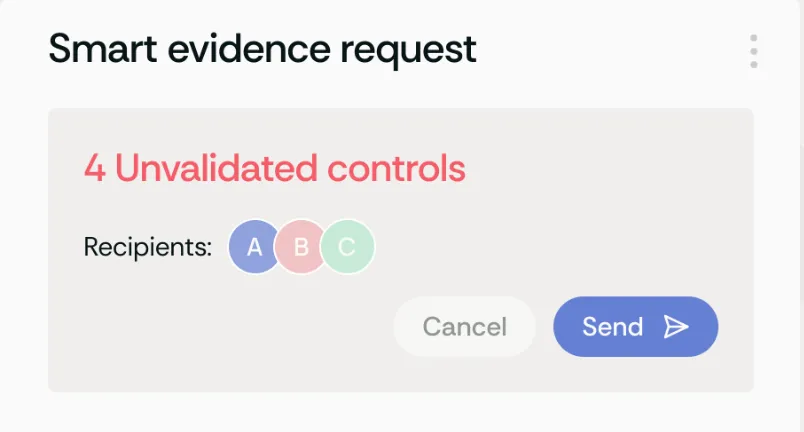
The right TPRM platform should invert the workflow: gather first, then ask only what's missing. The platform needs to automatically fetch publicly available materials from vendor trust centers and certification bodies, run a gap analysis against your control framework, and generate vendor-facing requests only for unresolved gaps. Instead of 250 SIG questions and an 8-week wait, the vendor gets three targeted questions about the exact controls that lack evidence, and responds in days rather than months. The result is a 90%+ reduction in turnaround time, higher-quality responses, and assessment teams unblocked from the questionnaire bottleneck that has traditionally gated vendor onboarding.
{{banner-small-3="/inline-cards"}}
Conclusion
These six features represent the minimum technical bar for TPRM software that actually protects against third-party breaches. The common thread among these features is that each demands going beyond what third-party vendors claim to understand and what is factually true, connecting that truth to your specific environment and addressing the gaps with cited evidence.
Most TPRM tools today were designed for compliance officers who need to demonstrate processes. The next generation must be designed for risk engineers who investigate, validate, and remediate third-party exposures.
Ask whether your current program can forensically validate claims with cited evidence, continuously track blast radius, produce compliance documentation as a byproduct, score risk contextually, detect posture degradation between assessments, and engage vendors only on what's actually missing. If it cannot, you're operating on stale confidence, and the 48% of breaches now coming through third parties suggests that the confidence is increasingly misplaced.