
Introducing Third-Party AI Governance

You approved the vendor. But what about the AI it added later?
An existing SaaS provider can add an AI assistant, introduce agentic capabilities, or connect to a new model provider after the vendor has already been approved. At the same time, employees can adopt standalone AI tools directly, through SaaS sign-ups, browser or IDE extensions, OAuth connections, APIs, or MCP servers, without ever entering the traditional procurement or third-party review process.
The challenge isn't simply knowing which vendors use AI. It's understanding what that AI can do, what data and systems it can access, who sits behind it, and whether its actual use still matches what was assessed and approved.
Today, we're introducing AI Governance, built to help organizations understand and manage AI risk across their third parties.
Lema connects third-party risk context with what security can observe in the environment, helping teams discover AI, assess its exposure, continuously monitor how it changes, and identify where actual usage has drifted from the approved state.
Understand the Exposure Behind AI
Not all AI creates the same exposure.
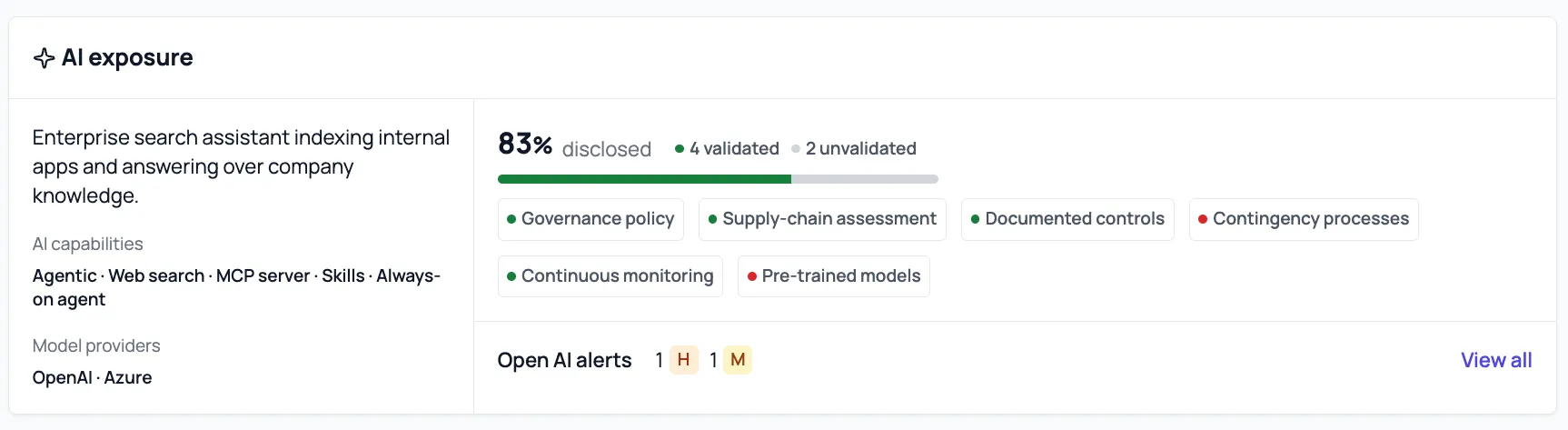
An assistant that summarizes documents is fundamentally different from an agent that can execute code, search the web, connect through MCP, or take actions across enterprise systems. The risk depends on its capabilities, the data it uses, the access and permissions it has, and the model providers and other fourth parties behind it.
Those dependencies can also create exposure across the portfolio. Multiple vendors may rely on the same model provider, meaning a single provider incident, policy change, or security issue can affect many third-party relationships at once.
AI Governance requires understanding that context, not just when a vendor is first assessed, but as its capabilities, dependencies, and use evolve.
See Your Third-Party AI Inventory
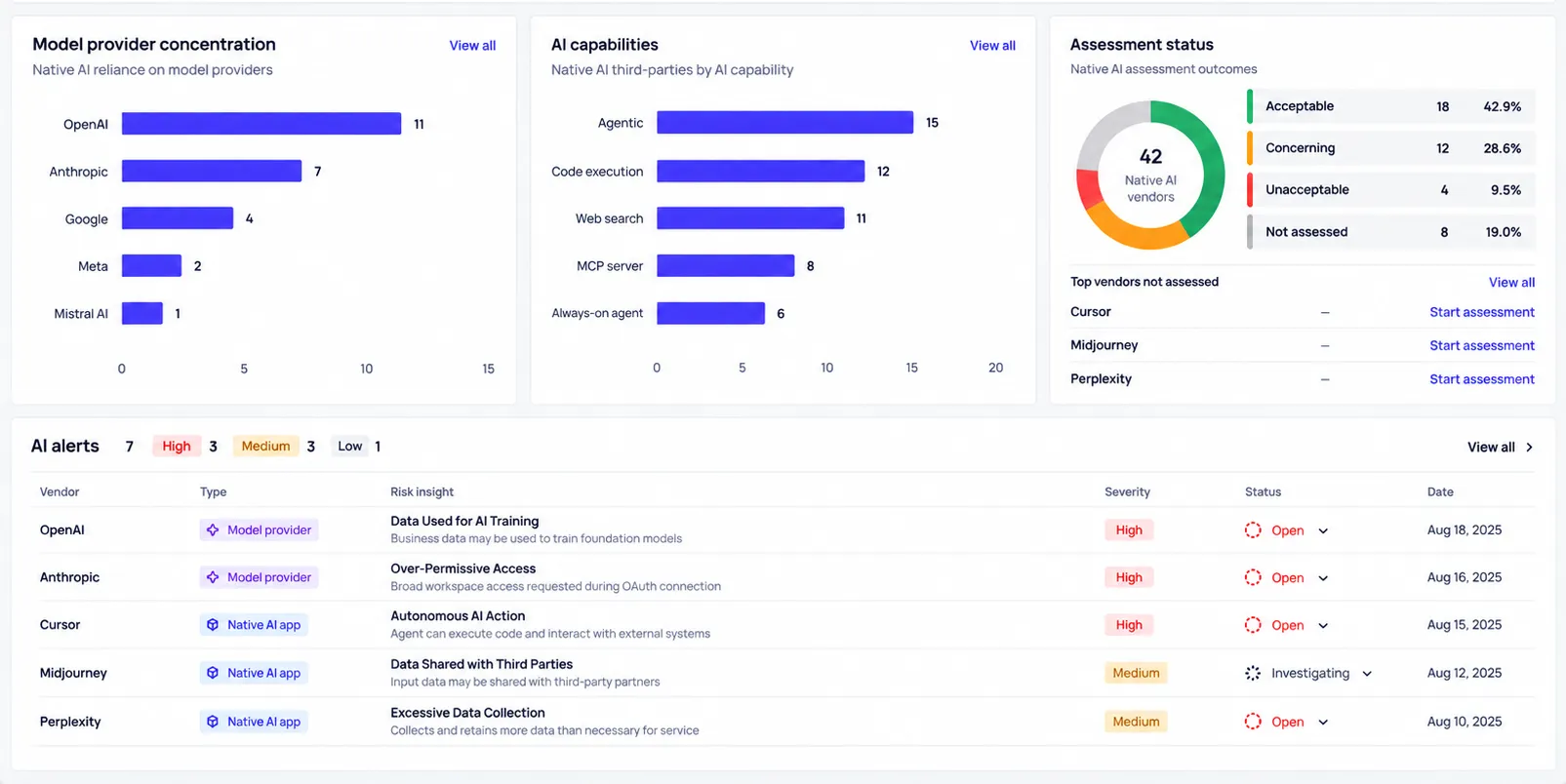
Lema identifies and classifies AI across third parties and products, including model providers, AI-native applications, and products with embedded AI capabilities.
Teams can understand the capabilities behind each relationship, including agentic functionality, web search, code execution, MCP, and other AI capabilities, while mapping the model providers powering them.
This creates a portfolio-wide view of where AI is being used, where dependencies are concentrated, and which previously unreviewed AI applications need to be brought into the governance process.
Assess AI in Context
AI introduces questions that traditional vendor assessments were not designed to answer on their own.
Lema supports dedicated AI assessment scopes and controls, including NIST AI RMF, as well as custom controls that can adapt to any business risk program and requirements.
But assessment should not stop with what a vendor claims.
Lema's Forensic Assessment goes beyond reviewing vendor responses in isolation. It cross-checks vendor claims against submitted artifacts, identifies contradictions across the evidence itself, and compares both with what Lema can independently observe through connected systems. This helps teams identify where the claimed, documented, and observed state do not align.
Monitor How the Exposure Changes
Approval is only the starting point.
Lema continuously surfaces AI-specific risks such as data used for model training, excessive data collection, retention issues, fourth-party data sharing, autonomous actions, and code-execution exposure.
It can also compare observed access, permissions, and deployment with what was approved, surfacing scope drift when a vendor's actual footprint moves beyond the expected state.
This is where security and GRC come together: what the vendor says, what the organization approved, and what is actually happening in the environment.
One View of Third-Party AI Risk
AI Governance extends the third-party risk workflows already available across Lema, including discovery, vendor inventory, fourth-party mapping, assessments, monitoring, and real-world exposure.
Instead of managing AI as a separate inventory or questionnaire exercise, teams can see it as part of the same third-party risk context.
What AI Governance Covers
AI Governance gives teams a consolidated view of the AI exposure behind their third-party portfolio, from inventory and assessment through continuous monitoring.
- AI classification across vendors and products. Identify model providers, AI-native applications, and products with embedded AI.
- AI capabilities and agentic behavior. Understand capabilities such as agents, web search, code execution and MCP servers that change the risk profile.
- Model provider and fourth-party concentration. Map the providers behind your vendors and see where shared dependencies create portfolio-level exposure.
- AI-specific forensic assessment. Assess against AI frameworks, including NIST AI RMF and custom controls, cross-checking vendor claims against artifacts, conflicting evidence, and independently observed data. See which vendors have been reviewed and which have not.
- Continuous monitoring and drift. Detect new AI capabilities, model providers, data practices, access and permissions, and usage that moves past what was approved.
- Actions that reduce the exposure. Product settings, access changes, vendor requests and contract terms, each routed to the team that owns it.
See where AI is being used. Understand the exposure. Bring it under control.
Key Takeaways


OUR RESOURCES
Level up with Lema


Checkbox TPRM is Dead. Start Engineering Risk

What is a Risk Engineer?
.webp)

.svg)
.svg)