
6 Essential Steps for Supplier Risk Mitigation

.svg)
Vendor risk programs rely on documents provided by vendors. No one checks those documents against what the vendor is actually doing. And the whole process is annual, even though the vendor relationship, access, integrations, and the vendor itself are constantly changing in between. That's why documented programs still leave organizations exposed.
In fact, over the past two years, nearly 30% of cyber breaches have been linked to the technology supply chain, with single-vendor failures causing cascading impacts across organizations. Most companies already have supplier risk mitigation in place, but it is still anchored to the assessment itself. Once a vendor is approved, the focus shifts elsewhere, while the relationship continues to evolve in the background. The challenge is to see how your organization actually uses each vendor, where that use creates exposure, and how that exposure develops over time.
What Is Supplier Risk Mitigation, and Why Is It More Important Than Ever?
Supplier risk mitigation is the practice of identifying, assessing, and reducing the risk introduced by third-party vendors throughout their lifecycle, from onboarding to offboarding. In practical terms, it means understanding how each supplier interacts with your systems, data, and operations, and ensuring that these interactions do not introduce unacceptable exposure.
Today, risk no longer sits inside assessment outputs or compliance reports. A vendor can appear secure on paper while still creating exposure through its integrations and what it can access. Data handling is often opaque, especially in AI-driven tools, and access tends to expand well beyond what was originally approved. At the same time, vendors themselves change due to incidents, operational shifts, or external pressures that are not captured in a questionnaire.
Visibility is further complicated by how vendors are actually adopted. Tools are introduced outside formal procurement, used across teams in ways they haven’t been assessed, and connected to environments without a full understanding of the implications. By the time they appear in a formal supplier risk assessment, they may already have meaningful access to systems or sensitive data.
6 Essential Steps for Supplier Risk Mitigation
Step 1: Eliminate Blind Spots in Your Vendor Inventory
Many suppliers are approved for one use case and then expand into additional systems, teams, or data without triggering a reassessment. The first step is to rebuild the inventory using live operational data. GRC software may support the process, but the inputs come from identity providers, finance systems, SaaS management platforms, and security tooling.
Pulling from SSO reveals which applications are actually in use, finance data confirms which vendors are active, and security integrations show how those vendors connect to internal systems. This is also critical for identifying shadow IT: unsanctioned applications or vendors that employees adopt outside formal procurement or security review processes. Without these inputs, teams rely on declared usage rather than observed behavior.
The inventory should show who uses the vendor, what systems it connects to, what data it touches, whether it supports a critical workflow, and whether it introduces fourth-party concentration through shared infrastructure or subprocessors.
Step 2: Replace Assumptions with Verified Risk
Most assessments still depend on vendor-provided documentation that reflects what a vendor chooses to disclose, not whether controls are operating as expected. Replacing this requires shifting to evidence-based validation. Risk should be derived from what can be confirmed, whether it's control implementation or inconsistencies across artifacts, rather than inferred from completed questionnaires and materials that vendors decide to share. This is especially important in environments where AI data governance is a concern, and where vendors' handling, processing, or reuse of data is not always clearly documented.
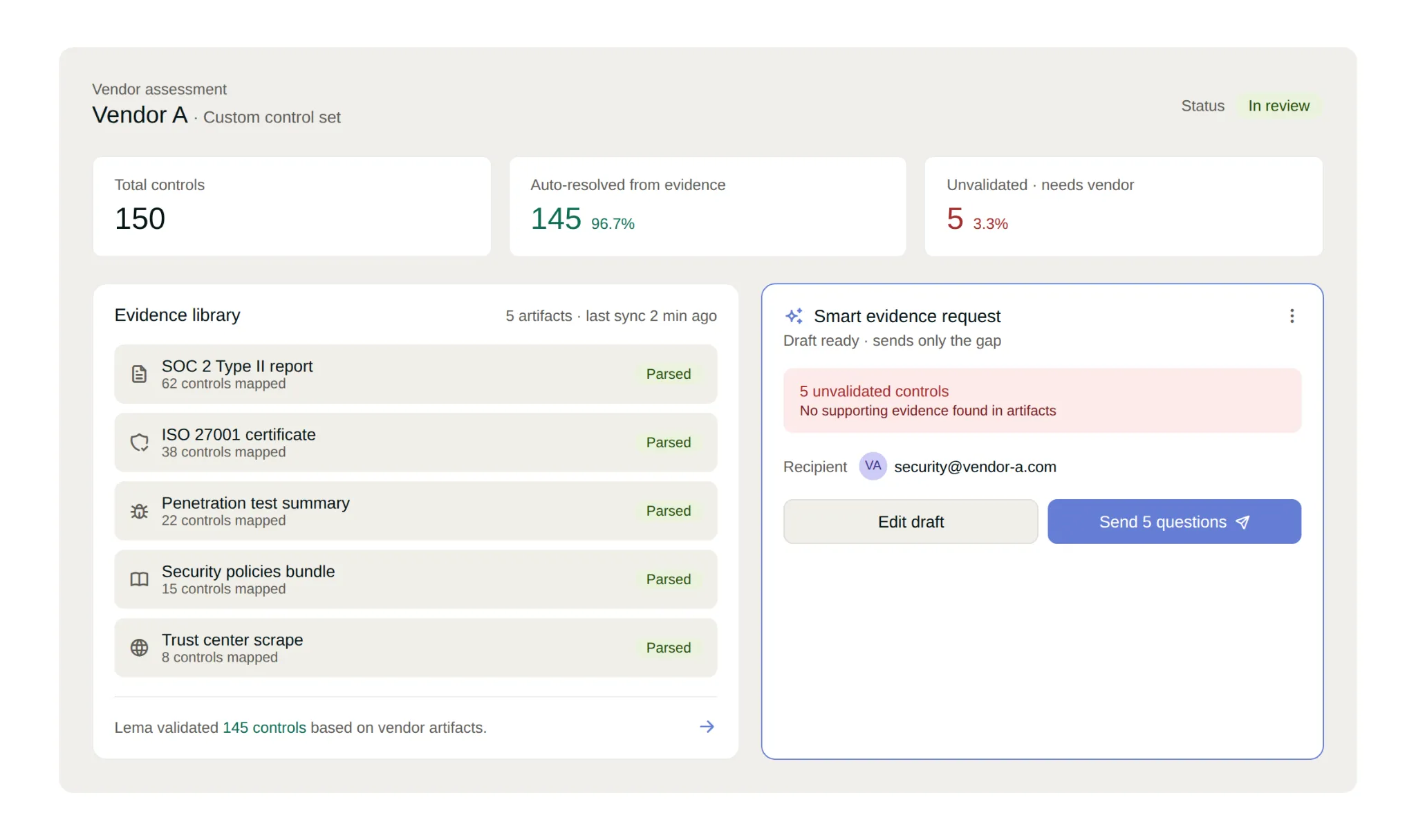
Lema’s Forensic AI Assessment automatically analyzes vendor artifacts, including SOC 2 reports, policies, and security documentation, and performs an artifact gap analysis to identify missing controls and inconsistencies against your requirements. Instead of issuing broad questionnaires, it generates Smart Evidence Requests that focus only on areas where evidence is incomplete or contradictory.
These capabilities change the nature of the assessment. Vendor input is no longer treated as ground truth but as a signal that needs verification. The output is a set of evidence-backed findings that can be defended and acted on.
Step 3: Correlate Risk Signals Across Sources
Risk does not sit in a single data source. Documentation, external intelligence, and internal usage each provide a partial view, but none are useful in isolation. The problem most teams face is the inability to connect them.
Effective mitigation requires bringing these signals into the same context. A disclosed breach matters only if the vendor has meaningful access. A missing control matters more if the vendor is deeply integrated into critical systems. Without correlation, teams either overreact to noise or overlook material exposure.
This requires combining three inputs in practice: vendor artifacts, external intelligence such as breaches or adverse media coverage, and internal telemetry showing how the vendor is actually used. The objective is not to collect more data, but to determine whether a signal translates into real exposure within your environment.
Step 4: Map Vendor Risk to Real Business Impact
Most risk programs stop at identifying issues at the vendor level. A vulnerability might be flagged, or a control might be missing, but neither explains what it actually means for your business.
Blast radius, meaning the scope of access, data exposure, operational dependency, and potential business impact tied to a vendor, starts with understanding where that vendor sits in your environment. That means identifying what systems it connects to and how dependent the business is on that relationship. In practice, this requires pulling from identity systems, integration logs, and application usage data to see how the vendor is actually embedded.
From there, the goal is to identify which vendors can materially impact the organization. A tool with limited access and no critical dependencies does not carry the same risk as one integrated into production systems or one that handles sensitive data. This is also where single points of failure become visible: vendors that sit in critical workflows or concentrate risk across multiple teams or systems.
Most tools surface signals such as open ports, certificate issues, or isolated vulnerabilities, but treat vendors as standalone entities. Without context, those findings only generate noise. Lema’s Agentic TPRM and Risk Engineering platform approaches this differently through Blast Radius Monitoring. It maps the interface between your organization and each vendor by tracking real usage, access, and dependencies through integrations with security and IT systems.
Instead of surfacing disconnected signals, it focuses on where you can prove an actual attack path, linking technical findings to real exposure. This capability allows teams to prioritize based on business impact: what a vendor can actually affect, not just what issues exist in isolation.
Step 5: Detect Drift Before It Becomes Exposure
Supplier risk rarely stays static. It shifts gradually as your team’s use of a vendor evolves, often without anyone revisiting the original assessment. To catch this, organizations need ongoing monitoring tied to relationship and environmental changes, not point-in-time review cycles. A new integration, expanded permissions, increased usage, or access to additional data should immediately trigger action to mitigate the resulting risk, because these changes often signal that the vendor relationship has moved beyond its original approved scope.
Organizations also need visibility into how vendor usage evolves after onboarding. Expanded permissions, additional users, broader integrations, access to more sensitive data, and unsanctioned AI or SaaS adoption can significantly increase exposure without triggering a reassessment. This is where Blast Radius Monitoring becomes critical. Blast radius refers to the scope of systems, data, users, and operational impact a vendor can affect inside the organization.
Lema continuously monitors how third parties are actually used across the environment, detects scope drift from the original business intake, identifies unsanctioned vendors and Shadow AI, and tracks changes in access, integrations, and usage over time. Rather than relying on static, inherent-risk assumptions, Lema correlates relationship signals through Agentic Risk Engineering to surface material exposure before it becomes a security incident.
Step 6: Turn Risk into Enforced Action
Identifying risk is not the outcome. The outcome is a change in how a vendor is allowed to operate in your environment.
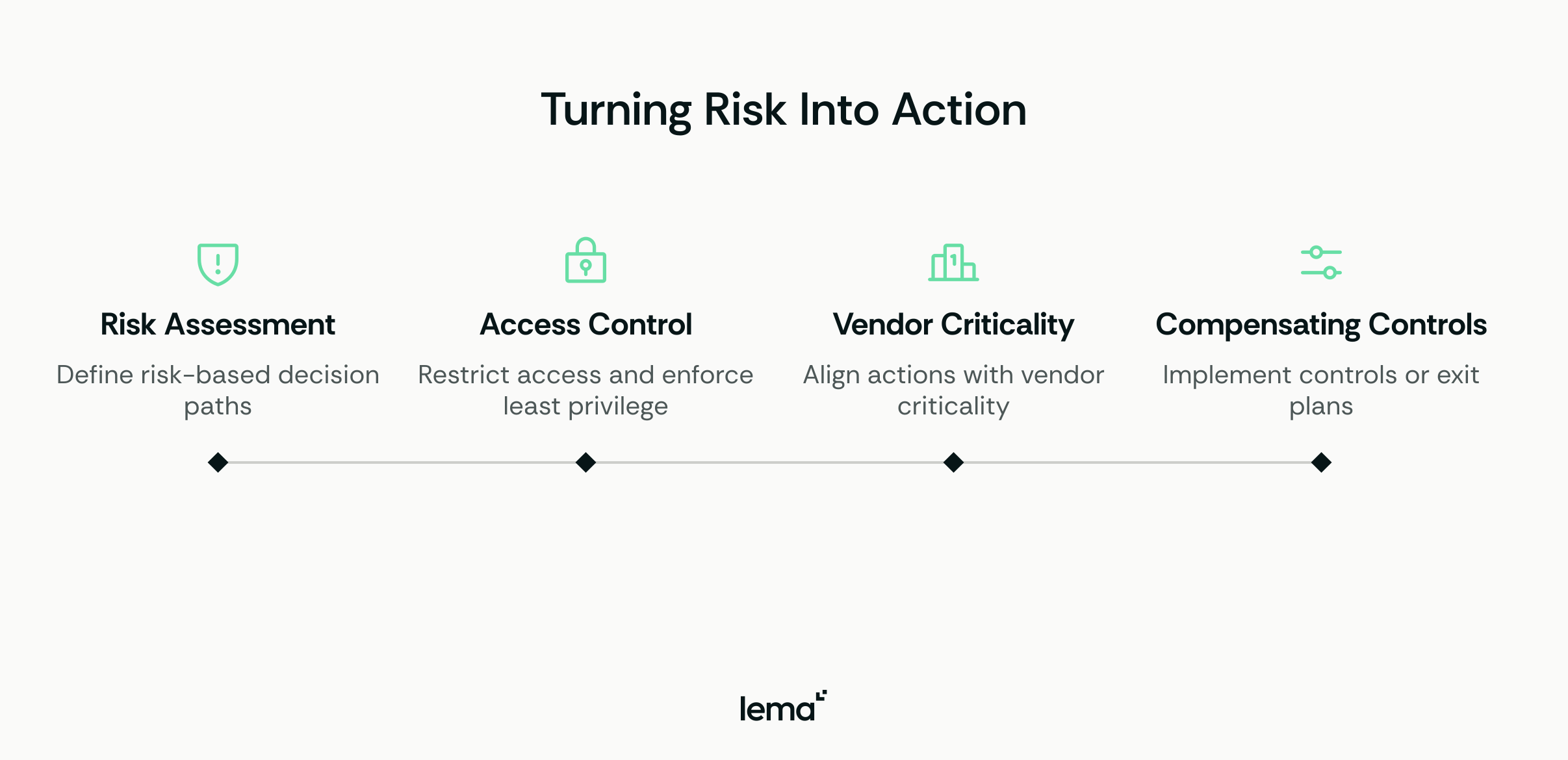
Define clear decision paths tied to exposure. If a vendor has access to sensitive data or critical systems, the response cannot be “monitor closely.” It needs to translate into concrete actions that reduce that exposure. That may include restricting permissions, enforcing least privilege, requiring admin approval for high-risk integrations, or disabling functionality that introduces unnecessary risk. In some cases, it means pushing the vendor for specific controls, such as access logging or defined data residency, before continued use is allowed.
Actions also need to reflect the vendor's criticality to the business, including the potential impact on customer trust and brand protection if that vendor is compromised. You can’t treat a deeply embedded supplier supporting core workflows the same way you treat a low-dependency tool.
For high-impact vendors, mitigation may involve introducing compensating controls or preparing an exit path if you can reduce risk to an acceptable level. For lower-impact vendors, the focus may be on limiting scope or reducing access rather than replacing the vendor entirely.
None of this works without ownership. Security may define the risk, but enforcement often sits with IT, engineering, or the business owner. Structure actions so your team can execute them through existing systems (access controls, identity management, procurement approvals, or ticketing workflows), rather than leaving them as recommendations in a report.
Supplier Risk Mitigation Checklist
How to Operationalize Supplier Risk Mitigation at Scale
What matters is whether the platform can continuously analyze vendor artifacts, ingest external intelligence, and track how your team uses each vendor inside the organization. Use those inputs to reconcile what was approved against what is actually active, then assign an owner, use case, data type, integration scope, and permission level to each vendor.
The second requirement is contextualization. Signals on their own are not useful. A breach or a missing control only matters if it affects your environment. The platform needs to connect those signals to vendor usage and access so teams can understand whether something is actionable or irrelevant.
Finally, the system needs to produce clear, defensible outputs. At scale, risk decisions cannot rely on manual interpretation. Teams need evidence-based findings that explain exactly how the issue impacts the business and what they should do next.
From A Checkbox Process to Real Risk Reduction
Lema operationalizes this model. As an agentic TPRM and Risk Engineering platform, it combines Forensic AI Assessment, OSINT Recon, and Blast Radius Monitoring to analyze vendor artifacts, collect external intelligence, and map how each vendor is actually used inside your environment. These signals are correlated through Agentic Risk Engineering to surface evidence-backed findings and precise remediation steps, allowing teams to move from analysis to reduction without relying on static assessments or vendor attestations.
Most vendor risk programs are built to document what vendors say, not to validate what they actually do. Book a demo to see what Lema finds that questionnaires and vendor attestations don’t surface.
