
Supplier Risk Assessment: The Step-by-Step Guide


Most supplier risk assessments are designed to satisfy audit requirements rather than to measure real-world exposure. They collect vendor documentation, map controls to frameworks, assign a risk rating, and move on. That creates a defensible process, but not necessarily a clear understanding of exposure.
IBM’s Cost of a Data Breach Report 2025 found that third-party vendor and supply-chain compromise was the second-most-prevalent breach vector and the second-most-costly on average, at $4.91 million per attack. Supplier risk is no longer a background compliance issue. It is a direct path to data exposure, operational disruption, and materially higher breach costs.
In most environments, vendors are deeply embedded across systems, data flows, identities, and business processes. Questionnaires and certifications can document intended controls, but they do not show how a supplier is actually connected to your environment, how that usage changes over time, or what the real blast radius would be if the supplier were compromised. A useful supplier risk assessment must produce an evidence-based view of real exposure.
What Is a Supplier Risk Assessment?
A supplier risk assessment is a process that establishes how third-party vendors introduce risk into an organization’s systems, data, and operations, and whether that risk is acceptable in context.
Most organizations implement supplier risk assessment as a checkbox exercise: collecting vendor documentation, mapping controls to frameworks, assigning risk ratings, and using those outputs to support onboarding and periodic reviews. That process creates consistency and scale, which matter when managing large vendor ecosystems.
What it does not inherently provide is validation. Vendor artifacts and certifications describe intended controls. They do not confirm how those controls perform in practice, whether your organization is enforcing them consistently, or how they interact with the way your teams use the vendor. They also say nothing about how that usage changes over time.
A more accurate assessment requires connecting three perspectives: what the vendor claims, what can be independently observed, and how the vendor is embedded within the organization. Without that, the process produces structured outputs, but limited insight.
10 Types of Supplier Risk
Supplier risk emerges from multiple sources, often interacting in ways that are not immediately visible. Some key risks include:
- Cybersecurity risk reflects vulnerabilities, misconfigurations, and incidents within a vendor’s environment that could be leveraged to gain access to systems or data.
- Software dependencies and supply chain risks arise from reliance on vendor-built software and shared components, where weaknesses can propagate across multiple customers simultaneously.
- Human and non-human identity risk is introduced through access granted to vendor users, service accounts, and integrations, often creating persistent entry points if not tightly controlled.
- Human dependency and subcontractor risks become relevant when vendors rely on individuals or external providers whose practices are not fully visible.
- Data exposure and handling risks are tied to how sensitive information is stored, processed, and transferred across environments.
- Operational resilience risk captures the potential for outages or service degradation to disrupt business-critical processes.
- Dependency and concentration risks arise when multiple functions rely on a single vendor, amplifying the impact of failure.
- Fourth-party risk extends exposure beyond direct vendors to their own suppliers, introducing indirect dependencies that are rarely assessed in detail.
- Financial and business stability risk reflects the vendor’s ability to sustain operations over time.
- Regulatory and jurisdictional risk is shaped by where the vendor operates and the compliance obligations that follow.
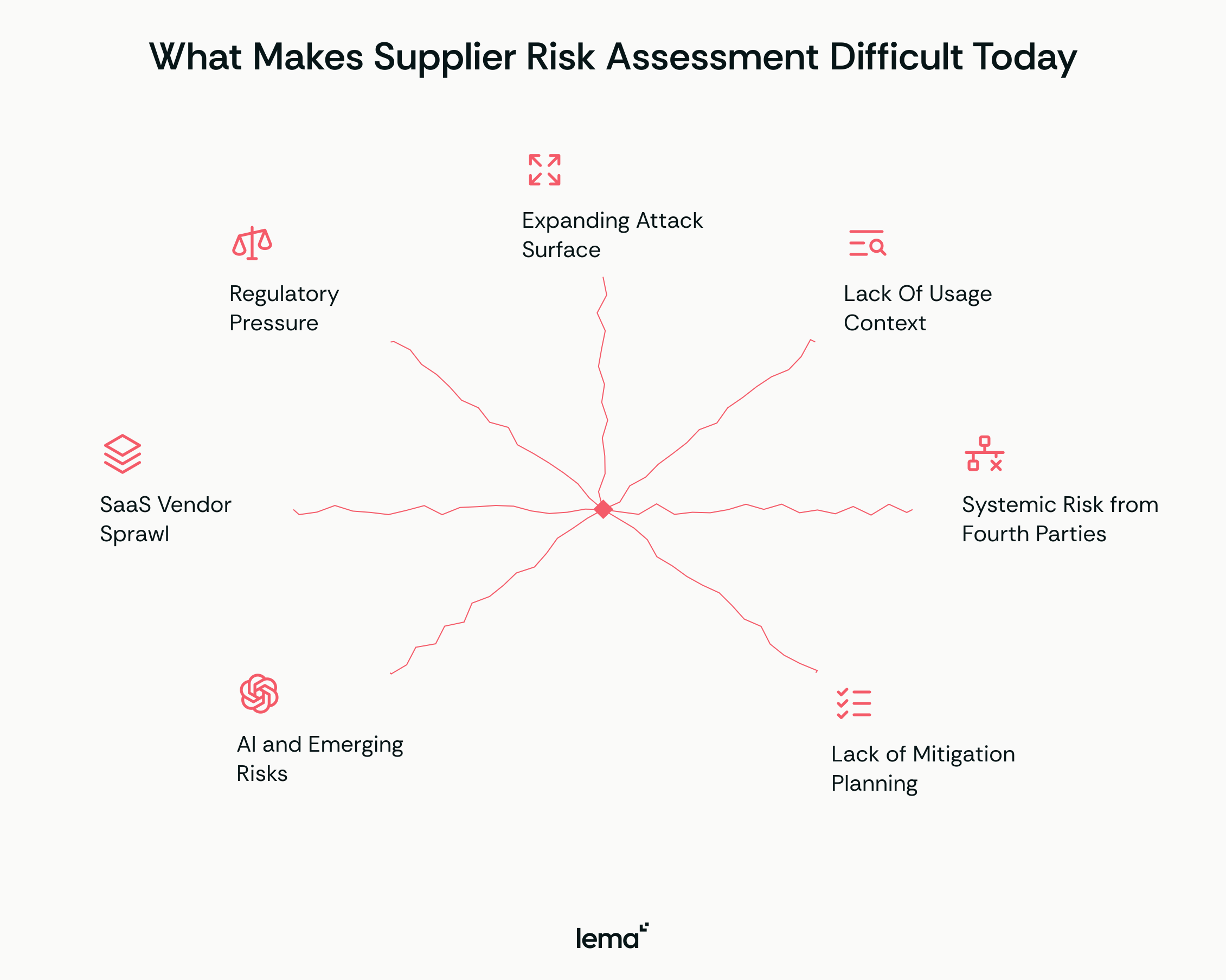
What Makes Supplier Risk Assessment Difficult Today
1. AI-Driven Vendor Risk and Emerging Unknowns
Suppliers are adopting AI faster than most assessment programs can adapt. New model features, changing data-handling practices, and unclear retention or training policies can materially change a supplier’s risk profile after onboarding, often without showing up in a questionnaire or certification review.
2. Vendor Sprawl and SaaS Dependency Growth
Third-party risk is no longer limited to a small set of strategic vendors. SaaS growth has expanded the number of suppliers embedded across business units, often with overlapping access to data, systems, and workflows, making it harder for teams to maintain an accurate picture of exposure.
3. Increasing Regulatory and Compliance Pressure
Regulations such as the EU’s Digital Operational Resilience Act (DORA) now explicitly require organizations to monitor third-party ICT risk on an ongoing basis, including subcontractor chains and concentration risk. In parallel, SEC cyber disclosure rules are increasing pressure to demonstrate not just that assessments occur, but that material risks are identified, understood, and reduced. Expectations are shifting from documentation to evidence of control over vendor exposure.
4. Expanding Attack Surface Across Vendor Ecosystems
In a recent case, a breach at government contractor Conduent exposed data of approximately 25 million individuals after attackers accessed backend systems used to process public-sector services. Suppliers now sit inside core systems, customer-facing processes, and interconnected technology stacks. That means a vendor incident is rarely isolated: it can affect operations, expose sensitive data, or create downstream disruption across multiple parts of the business.
5. Lack of Context Around Vendor Usage and Impact
A supplier’s risk level depends not just on its stated controls, but on how it is actually used. Without context around access, integrations, data flows, and business dependencies, teams struggle to distinguish routine findings from issues that could have a meaningful business impact.
6. Systemic Risk from Shared and Fourth-Party Dependencies
Risk does not stop with the direct supplier relationship. Vendors depend on subprocessors, shared infrastructure, external service providers, and software components that can introduce concentration risk and create failure points that many assessment programs never examine closely.
7. Lack of Defined Response and Mitigation Planning
Identifying supplier risk is not the same as reducing it. Without a clear process for prioritization, ownership, remediation, and follow-through, assessments can result in documentation and risk acceptance decisions that do not materially reduce exposure.
A Step-by-Step Guide to Supplier Risk Assessment
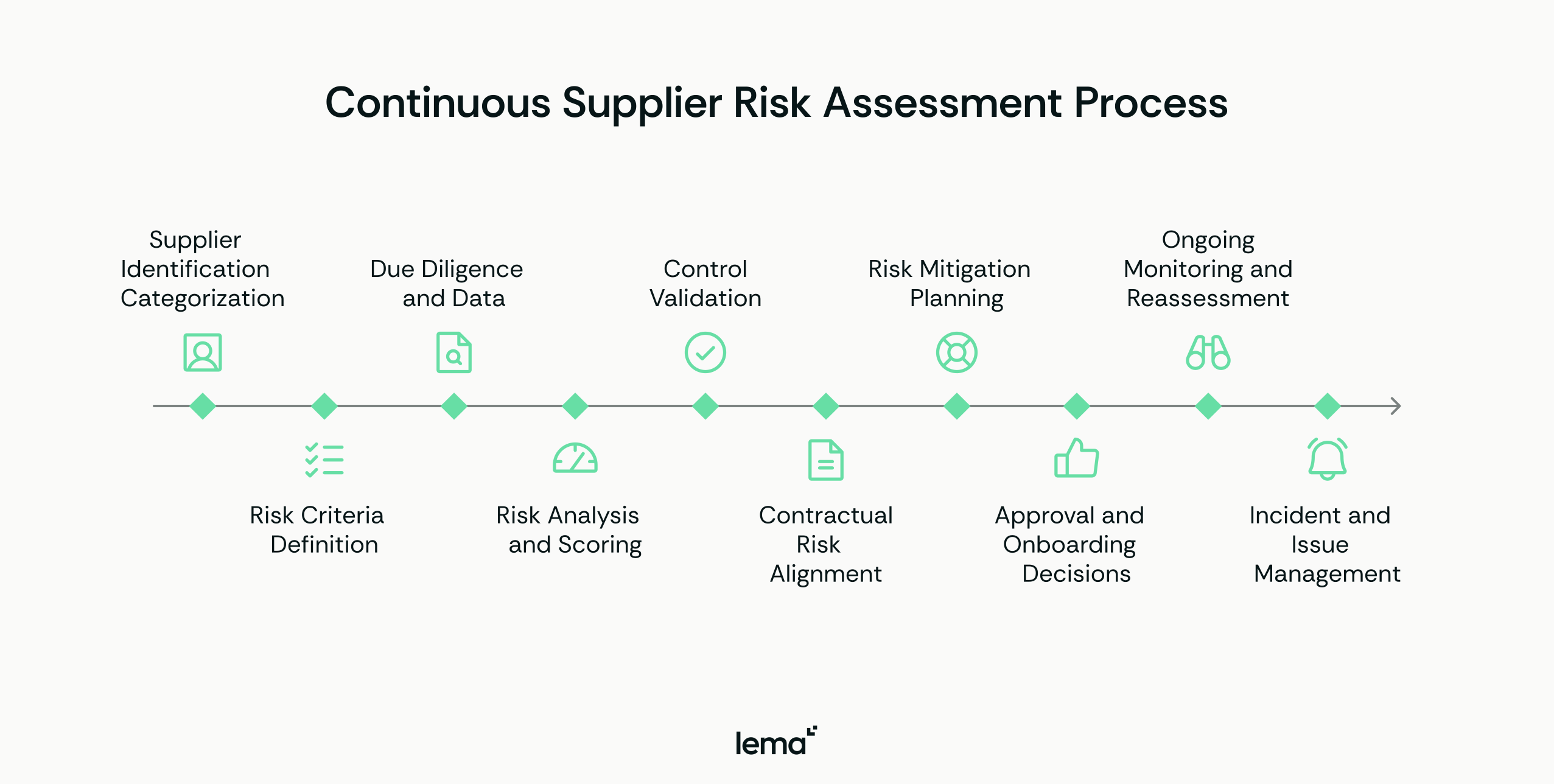
Step 1: Vendor Identification and Tiering
The first step is building an accurate view of the vendor landscape and determining where to focus assessment efforts. This requires going beyond procurement records. Finance systems reveal who is being paid, identity providers show which applications are in use, and cloud or security tools expose integrations that were never formally onboarded, including instances of shadow IT. When these sources are combined, it becomes clear that the official vendor list is often incomplete.
Tiering should then be based on exposure rather than perceived importance. The key inputs are access to sensitive data, the level of system integration, and operational dependency. A vendor with limited business visibility but broad access may introduce more risk than one supporting a critical function with tightly controlled permissions.
Where this step often breaks down is in incomplete visibility. Many programs assess only vendors that came through procurement, leaving a blind spot around unsanctioned SaaS and team-level purchases. Tiering also tends to rely too heavily on business-owner descriptions, which can understate the real sensitivity of the relationship.
Step 2: Relationship Context and Access Mapping
Once vendors are identified, the next step is understanding how they interact with the environment. This step involves mapping system access, data exposure, and usage across teams. Identity systems can show which users and service accounts interact with the vendor, while integrations and logs reveal how data moves between systems.
In practice, these integration paths often introduce access that is not fully understood or documented. For example, in a 2025 breach affecting 700Credit, attackers gained access through a compromised third-party integration partner, exposing data from over 5.6 million individuals after the vendor failed to disclose the incident.
Blast radius mapping is critical here, as it defines the scope of access, data exposure, operational dependency, and downstream impact associated with the vendor. Instead of asking whether a vendor is secure in isolation, the focus shifts to what would be affected if it were compromised.
In many environments, this mapping reveals that vendor access extends far beyond the original use case, including persistent API tokens, service accounts, and indirect access through shared infrastructure or identity providers. These paths are rarely visible in questionnaires but often define the true blast radius. The challenge is that this context is often treated as static. Assessments capture intended use at onboarding, but relationships change over time, so teams need to track those changes.
Step 3: Artifacts Collection and Validation
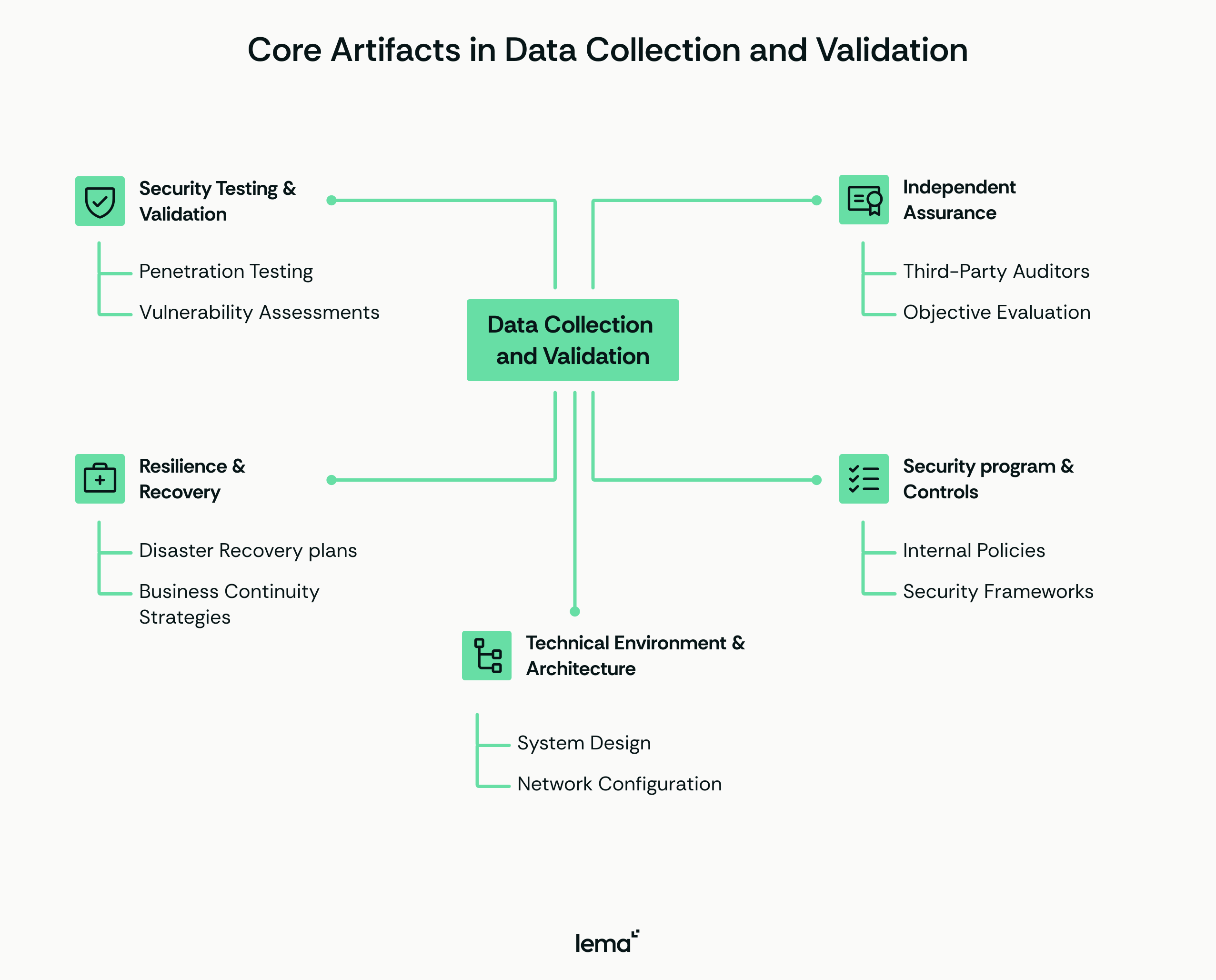
With context established, the next step is to collect and interpret vendor evidence. A practical approach starts with core artifacts, such as pentesting reports, SOC 2 reports, ISO certifications, policies, and architecture documentation, rather than leading with large questionnaires. These materials can establish a baseline, but they should be treated as input, not proof. Where evidence is incomplete, inconsistent, or ambiguous, teams should follow up with targeted validation.
Step 4: Security Posture Analysis
Step 4 is where validation shifts from reviewing claims to analyzing observable signals. External intelligence, such as trust center materials, policy disclosures, compliance artifacts, and adverse media, helps teams evaluate how the vendor operates in real conditions rather than relying solely on submitted material. These signals are most useful when interpreted in context, including a derived view of inherent risk: how critical the vendor is, what it has access to, and the potential impact if it fails.
That context comes from combining multiple perspectives. Lema’s Agentic TPRM platform combines Forensic AI Assessment (forensic artifact analysis and OSINT Recon) and Blast Radius Monitoring to surface risks that are both observable and relevant to the business. Together, those signals help teams distinguish meaningful exposure from noise.
Step 5: Risk Prioritization
Once risks are identified, teams need to prioritize them in a way that supports real decisions. Effective prioritization combines technical severity with business context. Teams need to assess how accessible the weakness is, which systems or data it affects, and how dependent the organization is on the vendor - effectively understanding the vendor’s blast radius, or the scope of access, data exposure, and potential impact on the organization.
Prioritization should result in a focused set of risks that clearly require action. A moderate issue in a deeply integrated vendor may carry more weight than a higher-severity finding in an isolated system with limited access. For example, a low-severity misconfiguration in a vendor with privileged API access to production systems may pose a greater material risk than a critical vulnerability in an isolated tool with no sensitive access.
Many scoring models break down at this stage because they flatten context. They rely on predefined criteria without reflecting on how the vendor is actually used, which produces large volumes of findings that are difficult to act on.
Step 6: Remediation and Risk Reduction
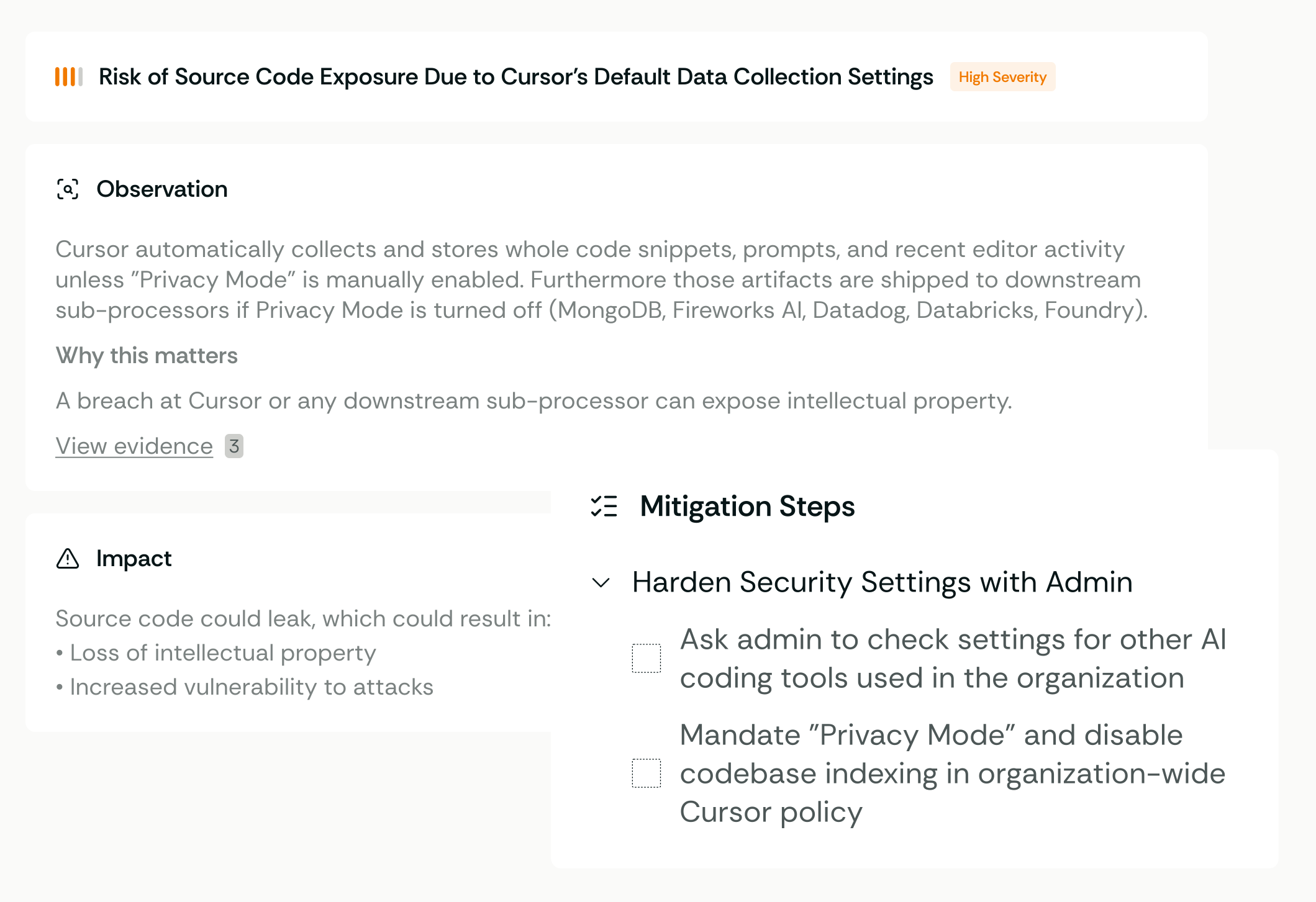
At this stage, the focus shifts from analysis to action. Each identified risk needs to translate into a specific, evidence-backed remediation step, whether that means improving controls, limiting access, or changing how the product is configured. Internally, remediation needs ownership and visibility inside existing workflows.
Where many programs fail is not in identifying issues, but in closing them. Without clear accountability and integration into operational workflows, remediation becomes inconsistent, and risk acceptance becomes the default.
Through its Agentic Risk Engineering, Lema connects vendor artifacts, external intelligence, and real usage context to produce evidence-backed findings and precise remediation steps tied to actual exposure. Teams receive clear, actionable guidance that integrates directly into existing workflows, moving from identification to resolution efficiently.
Step 7: Continuous Monitoring
Supplier risk evolves after onboarding as vendors change their infrastructure, introduce new features, and adjust how they handle data. Internal usage also grows over time as more teams adopt the tool, new integrations are added, and access across systems increases.
Continuous monitoring keeps the assessment aligned with these changes by tracking external intelligence, vendor updates, and internal usage. This includes signals such as newly disclosed vulnerabilities, changes to privacy policies, added subprocessors, or shifts in how the vendor is used across the organization.
Point-in-time assessments miss this by design. They capture a snapshot, but risk changes between reviews. A vendor that was low-risk at onboarding can become high-risk as its role expands or its posture changes. Lema’s Blast Radius Monitoring tracks how each vendor is actually accessed across systems, what data it touches, and how usage evolves, detecting scope drift and unauthorized expansion before it increases exposure.
Reassessment Triggers
Continuous monitoring also involves knowing when signals require action. Effective programs define clear reassessment triggers that initiate a deeper review when risk meaningfully changes. These triggers typically include:
- Significant changes in vendor access, integrations, or data exposure (blast radius expansion)
- Detection of new vulnerabilities, breaches, or adverse external intelligence
- Updates to vendor policies, subprocessors, or security controls
- Evidence of scope drift between the original use case and current usage
- Internal changes in how the vendor is relied upon across business units
Lema operationalizes this through Continuous Risk Signal Collection, combining external intelligence, vendor inputs treated as signals rather than ground truth, and internal telemetry to maintain an up-to-date view of supplier exposure as conditions evolve. By correlating these signals with blast radius mapping, the scope of access, data exposure, and potential business impact, it highlights when changes materially increase risk and where reassessment is required, enabling teams to act on evidence and reduce exposure before issues escalate.
Checklist
Moving Supplier Risk From Process to Exposure
Most organizations already have a supplier risk assessment process. The problem is that many of those processes are built to generate documentation, not to validate real-world exposure. A step-by-step framework only creates value when each stage improves your understanding and drives action.
Lema helps teams do that by combining Forensic AI Assessment, which includes forensic artifact analysis and external intelligence through OSINT Recon, with blast radius monitoring and continuous risk signal collection into a more accurate view of supplier exposure. Instead of replacing existing workflows, it upgrades them, helping third-party risk teams operate more like risk engineers: using evidence, context, and exact remediation steps to reduce material exposure.