
Third-Party Risk Monitoring: A Complete Guide

.avif)
Most third-party risk programs look disciplined on paper. However, they focus solely on compliance, questionnaires, and documentation collection, not on risks. That paperwork rarely shows how a vendor is actually used, what it can really access, or where exposure has expanded since onboarding. Therefore, teams stay busy while real exposure remains unknown.
Verizon’s 2025 Data Breach Investigations Report found that 30% of breaches involved a third party, roughly double the prior year, a reminder that vendor risk is an active security exposure, not just a compliance exercise. Monitoring is not an annual audit. It is a set of capabilities for validating vendor claims, tracking change, and tying findings to actual business impact.
What Is Third-Party Risk Monitoring?
Third-party risk monitoring is the continuous collection, validation, and analysis of signals that indicate how vendor risk is changing over time. It is an ongoing capability designed to show whether a vendor’s actual risk posture, relationship scope, or potential impact has changed since it was approved.
That makes it fundamentally different from third-party risk assessment. An assessment is a point-in-time judgment: Is this vendor acceptable based on the information available during review? Monitoring is what happens after that. It asks whether new vulnerabilities, breaches, changes in usage, access expansion, or contradictory evidence have altered the organization’s exposure since that original decision.
Vendor risk is dynamic. New software flaws emerge, vendors experience incidents, internal teams expand usage without re-evaluation, and integrations deepen. A vendor that looked low-risk six months ago can quickly become a material source of exposure. Effective monitoring provides teams with the information they need to investigate exposure, validate claims, and make decisions the way a risk engineering function should.
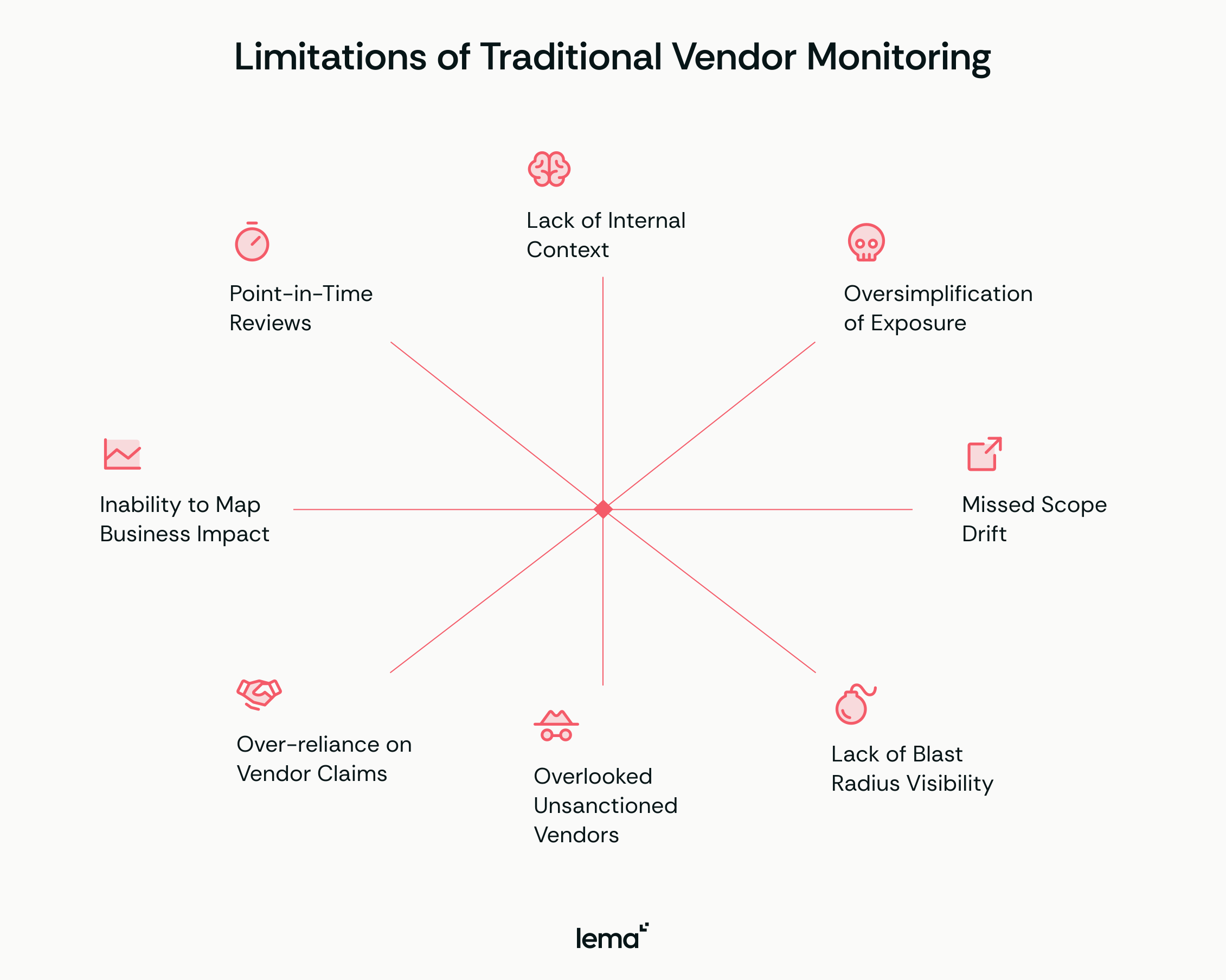
Why Traditional Monitoring Approaches Still Miss Material Risk
They Do Not Account for Actual Usage
Many tools still evaluate vendors as standalone entities; they do not show how a vendor operates inside the business. Teams see that something happened without understanding whether it impacts a low-value tool used by a small group or a provider deeply embedded in critical systems. A vendor is not risky in the abstract. It is risky in the context of your environment.
They Fail to Map Business Impact
A risk finding only matters if it connects to operational consequences. Teams need to understand what data a vendor touches, which systems depend on it, how widely it is used, and what would break if it failed. Traditional programs stop at documentation, leaving findings too abstract to prioritize.
They Reduce Complex Exposure to Scores
Security ratings reduce vendor risk to a single number, but that number tells you almost nothing about real exposure. It feels like security, but it’s just a sophisticated way of checking a box. These scores rely on scanning public-facing infrastructure, so a vendor can earn an “A” for a well-configured marketing site, while the systems that actually matter remain unassessed. They also ignore blast radius, treating a vendor with deep API access the same as a low-impact supplier, while teams waste time chasing irrelevant findings.
They Treat Vendor Claims as Evidence
Questionnaires, certifications, trust centers, and other submitted artifacts are not, in and of themselves, sufficient evidence. Traditional programs too often accept them at face value, which creates false confidence. Vendor-provided data is input, not evidence in itself, so it must be verified against independent intelligence and internal usage context.
They Miss Scope Drift
Over time, vendor usage expands through new integrations, permissions, and access to sensitive data, often outside formal review. Without detecting scope drift, exposure continues to grow even when the vendor’s original risk classification remains unchanged.
They Overlook Unsanctioned Vendors and Shadow IT
Some of the highest-risk vendors never go through formal onboarding. Tools adopted directly by teams can introduce access, data, and integration risks that remain invisible to security and procurement. Effective monitoring must account for these relationships.
They Lack Blast Radius Visibility
Blast radius is the scope of access, data exposure, and operational impact tied to a vendor relationship. While some tools attempt to model this, it is rarely tied to actual usage and access within the environment. Without that context, teams cannot tell whether a vulnerability is contained to a single team or capable of disrupting critical systems and business workflows.
They Remain Tied to Point-in-Time Reviews
Many organizations still rely on annual reassessments or occasional checkpoints to refresh their understanding of vendor risk. That approach is too slow. Point-in-time reviews are snapshots, but risk changes continuously, so monitoring has to reflect that.
Continuous Monitoring vs. Point-in-Time Assessments
6 Core Components of Effective Third-party Risk Monitoring
The following components can be implemented through internal processes, external platforms, or a combination of both. Together, these capabilities move third-party risk monitoring from compliance maintenance into a more risk-engineered approach to exposure.
1. Continuous Risk Signal Collection
Effective monitoring starts with broad, ongoing signal coverage. No single source tells the truth on its own. Teams need to correlate external intelligence, vendor-provided data, and internal telemetry to understand how vendor risk is actually changing over time.
External intelligence
Breaches, vulnerabilities, adverse media, and other public signals that indicate a vendor’s risk posture may have changed.
Vendor-provided data
Certifications, questionnaire responses, and other vendor-submitted materials that help explain controls, but still need to be validated.
Internal telemetry
Usage, integrations, access, and identity signals, including signals surfaced by SaaS, identity, and API security tools that show how a vendor actually operates in your environment.
Teams should treat vendor-provided data as untrusted input that must be validated, not accepted at face value. In practice, that means cross-checking vendor claims against independent evidence and actual internal usage. This collection layer should also account for unsanctioned vendors and shadow IT, since they often introduce risk without ever entering the formal assessment process. The goal is comprehensive, continuous coverage across sanctioned vendors, unsanctioned tools, and all meaningful sources of change.
2. Forensic Artifact Analysis
A vendor can appear well-controlled in submitted materials, while real gaps remain hidden in the details or contradicted by external evidence. Reviewing vendor documentation manually across SOC reports, certifications, trust materials, and questionnaires is often slow, inconsistent, and easy to game.
Forensic artifact analysis automates the review of submitted artifacts such as SOC reports, certifications, questionnaires, and trust materials to surface gaps, inconsistencies, and missing evidence. Instead of sending large, standardized questionnaires to every vendor, teams should use targeted, evidence-driven follow-ups that focus only on what is weak, missing, inconsistent, or unverifiable. Best practice is to use vendor documentation as a starting point, then test it against external intelligence from threat intelligence tools, known vulnerabilities, and other available signals to identify contradictions. This layer should also surface fourth-party dependencies, where downstream providers expand exposure beyond the primary vendor.
.svg)
3. Blast Radius Mapping
Blast radius mapping is where third-party risk becomes operationally meaningful. It defines the full scope of what a vendor can access, influence, or disrupt. That scope includes data access, application integrations, user dependencies, operational criticality, and business reliance across teams.
This mapping is what allows a security leader to ask: What happens to us if this vendor is compromised? That is the shift from traditional TPRM to risk engineering: not asking whether a vendor is acceptable in theory, but what the actual exposure looks like inside your environment. A strong practice is to define blast radius at onboarding, then update it as usage expands, integrations deepen, and dependency patterns change.
Tools like Lema offer Blast Radius Monitoring, continuously mapping how your team actually uses each vendor within the organization. By integrating with internal systems, the platform tracks real usage patterns, access to critical assets, and dependency depth across teams, while also detecting scope drift as relationships evolve beyond their original intent.
Instead of relying on intake assumptions or static classifications, teams can see what a vendor truly affects, and prioritize based on real business impact.
4. Continuous Change Detection
Vendor risk does not stay still. A provider may expand into new systems, introduce new integrations, suffer a newly disclosed incident, or accumulate vulnerabilities that change the risk calculation. Relationships also evolve internally, often without formal reassessment.
Continuous change detection is the capability to track shifts as they happen. It should detect scope drift, permission changes, new access paths, and shifts in vendor posture that invalidate the original assessment. Trigger-based reassessment is critical here. Instead of waiting for renewal or an annual review, teams should define the signals that require re-evaluation and route them into operational workflows. That can include new integrations, elevated permissions, incident disclosures, breach reports, or changes in how a vendor is used across the business.
5. Signal Correlation and Risk Prioritization
Security teams are not short on data; they are short on connected data. Vendor artifacts, external intelligence such as breaches and CVEs, and internal signals, such as integrations, access, and usage patterns, often live in separate systems. These silos force teams to piece together fragmented inputs to understand what actually matters. Effective monitoring requires more than aggregation; it depends on IT analytics to correlate these sources into a coherent risk narrative.
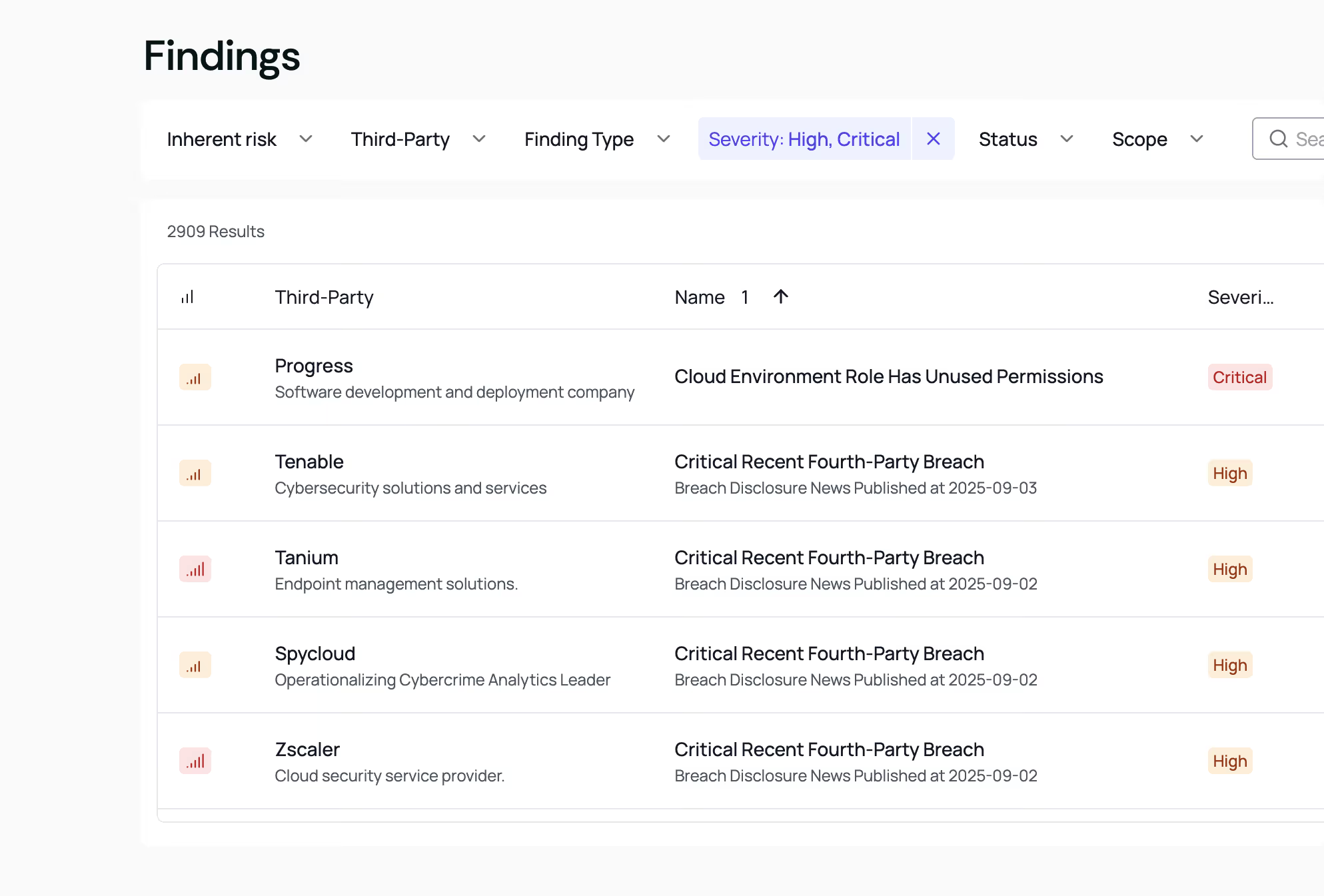
Lema’s Agentic Risk Engineering brings together vendor artifacts, external intelligence, and internal usage context into a single, coherent set of risk insights. These insights clearly show which risks are exploitable in your environment and where they will have the greatest impact, while remaining easy to understand across the organization and paired with actionable mitigation steps. Best practice is to prioritize based on exploitability in your environment, operational dependency, and likely business impact, rather than raw alert volume or generic severity labels.
Instead of handing teams disconnected alerts, ratings, and vendor claims, effective monitoring should surface prioritized, evidence-backed findings tied to actual systems, users, and business impact.
6. Operational Response and Lifecycle Integration
Visibility needs to translate into decisions and remediation. In many programs, that connection is weak. Findings are surfaced but sit outside operational workflows, leaving teams aware of the risk without addressing it.
When a vendor’s risk profile changes, that change should feed into existing workflows to prompt a response. Expanded access should not go unnoticed, and new exposure should not sit unresolved. At a certain point, the original assessment stops reflecting reality and needs to be revisited. That requires clear ownership across security, procurement, and business stakeholders, along with defined remediation paths, reassessment triggers, and escalation timelines.
This becomes more important over time because vendor relationships do not stay fixed. What starts as limited usage can evolve into something far more embedded, often without any formal reassessment. Monitoring needs to stay aligned with that shift, ensuring that risk signals reach the right owners and are acted on within existing operational processes. Effective programs also connect monitoring to the full vendor lifecycle, from onboarding and ongoing review to renewal and offboarding.
How to Evaluate Your Current Monitoring Stack
Third-party risk monitoring setups span TPRM tools, data sources, workflows, and ownership across security, risk, and the business. Most fail for one reason: they generate outputs that do not change decisions. The fastest way to evaluate yours is to examine what actually happens after a risk is identified.
Start with your outputs. Look at the last 10-20 vendor risk findings your team reviewed. Can you clearly see what each one affects (specific systems, data, or business processes), or are you looking at scores, summaries, or generic severity labels? If the output doesn’t show impact, the issue is missing context.
Then look at your inputs. What is your team relying on to form those conclusions? If most of it comes from vendor-submitted materials, you are basing decisions on what vendors choose to disclose, not what is actually true.
Next, examine how your tooling handles change. Pick a vendor approved 6–12 months ago and compare its original scope to how your team uses it today. Has access expanded? Are there new integrations? More users? If your monitoring does not automatically surface those changes, your risk view is outdated.
You should also look at how signals are connected. When a new vulnerability or external event is detected, does your system show whether that vendor is actually used in a sensitive context, or does it leave the team to investigate manually?
Finally, follow the outcome. When your team identifies meaningful risk, what happens next? Is there a clear owner, a defined action, and a tracked resolution, or does it end up in a report or dashboard? If the finding ends up on a dashboard rather than a decision, the stack is not reducing risk.
A strong monitoring stack makes a few things immediately clear: what a vendor currently has access to, how that access has changed over time, which risks are relevant in your environment, and what you need to fix first. These are critical capabilities you should look for in your tooling.
Third-Party Risk Stack Evaluation Checklist
Implementing Actual Risk Reduction
Most organizations lack meaningful visibility into the context and business impact of third-party risk, leaving them without a clear understanding of their true risk exposure. They complete reviews, log risks, and approve vendors, yet many teams still can’t answer a basic question with confidence: Where are we exposed right now? Without continuous visibility, evidence-based validation, and business context, third-party risk efforts become administrative maintenance rather than a capability the organization can genuinely rely on.
Lema’s Agentic TPRM platform helps third-party risk teams operate more like Risk Engineers. It combines forensic artifact analysis, open-source intelligence, blast radius visibility, and ongoing monitoring of vendor relationships to show actual exposure rather than assumed risk. Instead of overwhelming teams with disconnected findings or generic scores, it surfaces prioritized, evidence-backed risks tied to real business impact, so they can act before those risks become serious incidents.