
14 AI Governance Best Practices by Category

.svg)
Most AI governance programs still treat AI vendors as static software purchases, even though AI systems continuously evolve after onboarding. As AI adoption accelerates, businesses are now facing constant requests to approve new AI tools, existing SaaS platforms rapidly adding AI features, and growing shadow AI usage across teams without centralized oversight.
According to BSI, fewer than 24% of organizations currently have a formal AI governance program, and only 30% actively assess AI-related risks and mitigation measures. AI governance is now a Risk Engineering problem, as organizations need continuous visibility into how AI vendors operate and evolve. That requires evidence-driven oversight, continuous risk signal collection, and operational context - not just vendor attestations and point-in-time reviews.
What Is AI Governance?
AI governance is the framework organizations use to manage how employees select, deploy, access, and control AI systems across the business . It includes the policies, operational controls, and mechanisms that ensure AI technologies operate securely and in alignment with business objectives and regulatory standards.
Many organizations confuse AI governance with AI compliance, but the two are distinct. Compliance focuses on meeting external regulations and certifications through supplier risk assessments and other audits. Governance is broader. It covers how teams assess AI risk, control operational exposure, assign accountability, and actively validate whether AI systems remain safe and aligned with risk tolerance over time.
There is also a critical distinction between internal AI governance and third-party AI governance:
- Internal governance focuses on models and AI systems developed or managed directly by the organization.
- Third-party governance focuses on external AI vendors, copilots, SaaS platforms, APIs, and embedded AI tools that interact with sensitive systems or proprietary information. For many enterprises, that external layer has become the larger security and resilience problem.
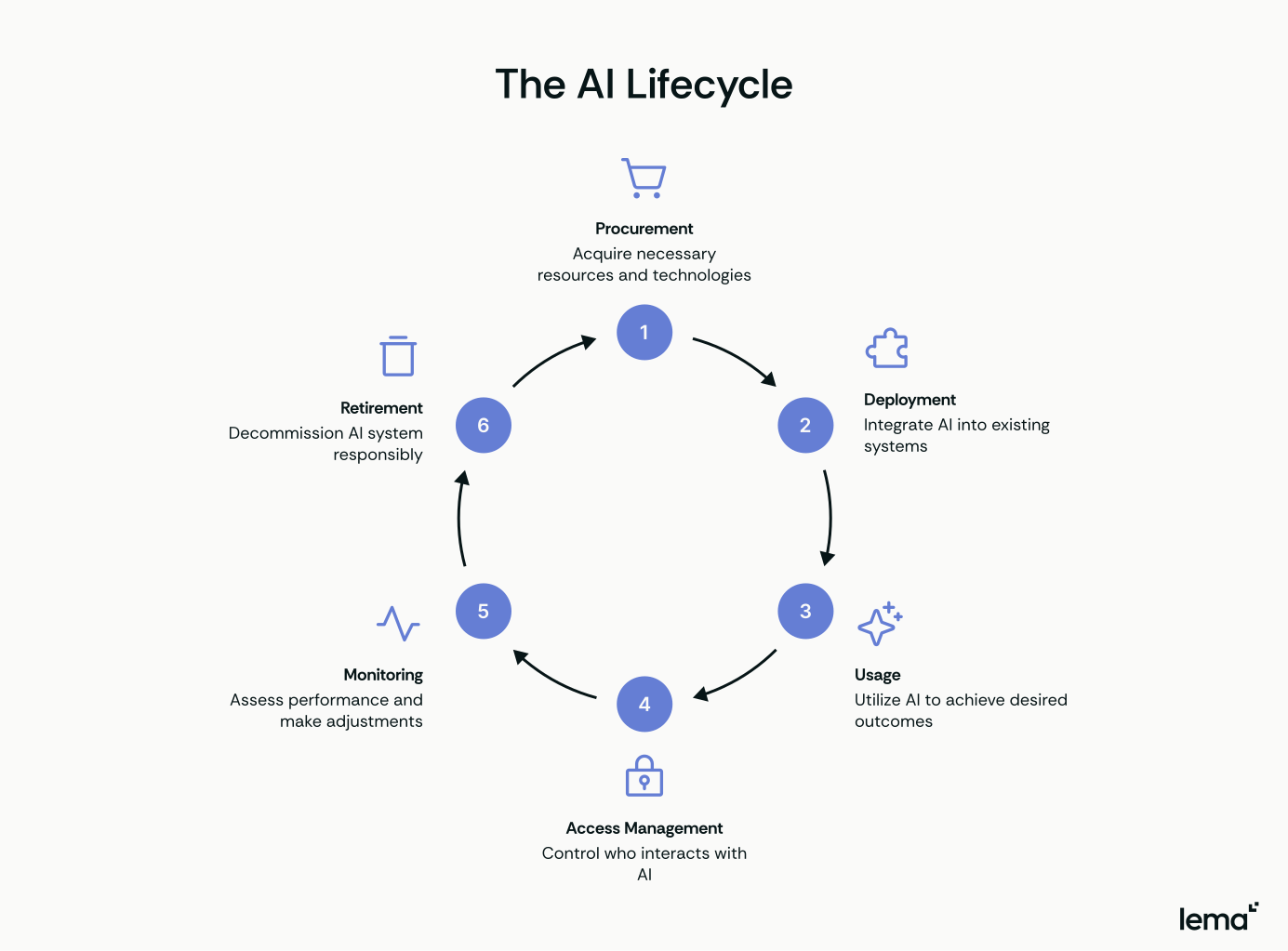
Modern governance must span the full AI lifecycle:
- procurement
- deployment
- usage
- access management
- ongoing monitoring
- retirement
AI governance failures increasingly create operational security and resilience problems rather than isolated compliance issues. AI systems influence customer operations, internal workflows, business continuity, and supply chains. When those systems fail, the impact rarely stays isolated.
AI Governance Frameworks and Standards You Should Know
Regulators and standards bodies are now scrambling to address AI oversight risks. While these frameworks are becoming increasingly important, they should be treated as governance foundations rather than complete solutions. Below are some of the most widely referenced standards you should keep in mind as AI governance matures:
- The NIST AI Risk Management Framework (AI RMF) helps organizations structure AI risk oversight and governance processes across the lifecycle. However, it does not provide operational visibility into how third-party AI vendors evolve after onboarding.
- ISO/IEC 42001 establishes governance standards for AI management systems, focusing on accountability, controls, risk management, and operational oversight surrounding AI technologies.
- The EU AI Act introduces legal obligations tied to risk categories, transparency, oversight, and prohibited AI practices. Many global organizations will still be affected even if they operate outside Europe.
- SOC 2 remains highly relevant because many AI vendors operate as SaaS providers handling sensitive customer data, business workflows, and cloud-hosted environments.
- ISO 27001 continues to provide foundational information security governance that supports AI-related access control, operational resilience, and vendor risk management.
Why AI Governance Is Now a Major Enterprise Risk Problem
AI sprawl is accelerating faster than most organizations can keep track of, as departments regularly adopt AI tools without involving the relevant teams. In many enterprises, no one has a complete inventory of which AI systems employees actually use. Some of the most common problems enterprises are facing include:
1. Shadow AI
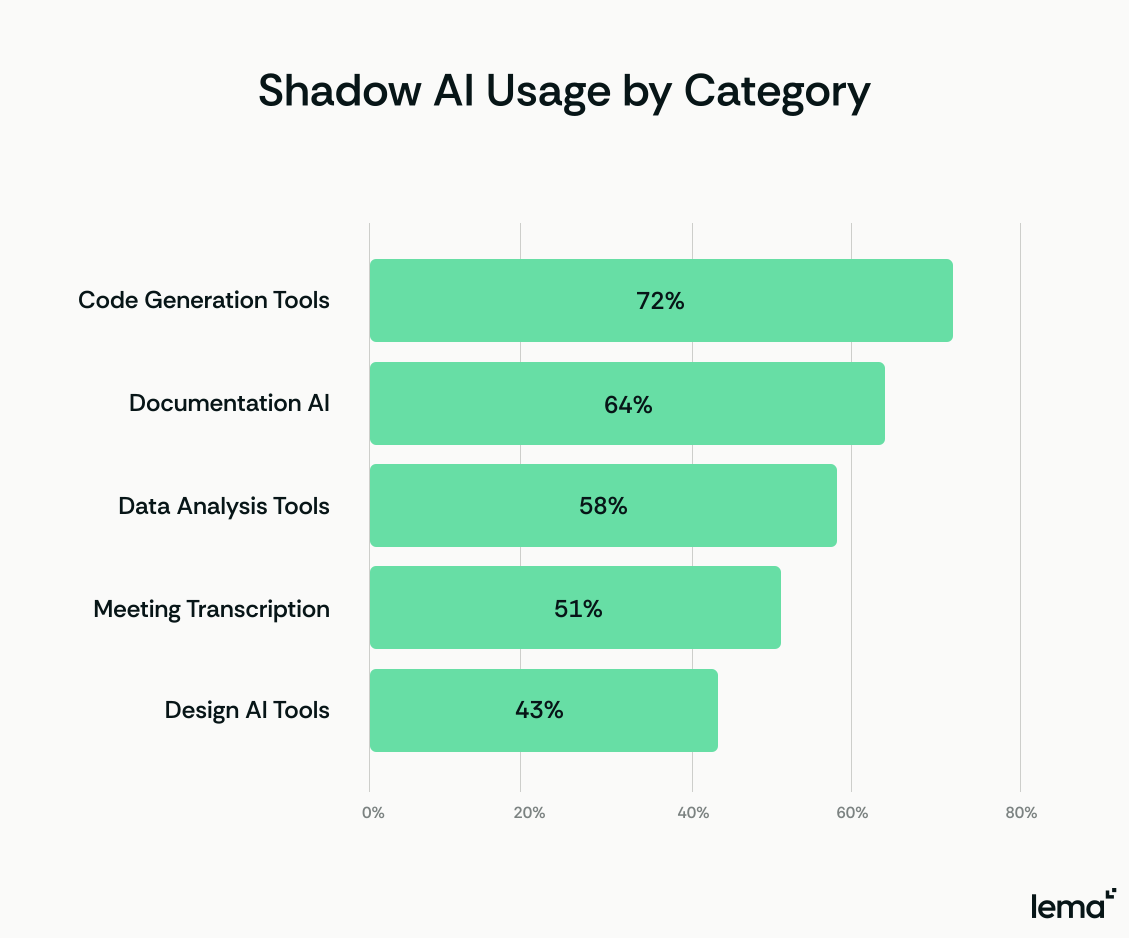
78% of AI users bring their own AI tools to work, often without formal approval. Employees increasingly use unauthorized AI tools for coding, summarization, research, automation, customer support, and document analysis. Those tools may process intellectual property or internal strategy documents entirely outside approved governance channels.
2. Third-Party Integrations
Third-party AI integrations are creating additional exposure. Vendors that previously offered standard SaaS functionality are rapidly embedding generative AI capabilities into their products , often introducing entirely new data-processing behaviors after onboarding.
3. API Exposure
Many AI systems rely on interconnected APIs, plugins, subprocessors, and external model providers that organizations do not fully review during onboarding. Even with API security tools in place, a single AI-enabled workflow can still introduce multiple third parties with access to sensitive data, internal systems, or operational processes.
4. Copilots with Excessive Permissions
Increasingly, organizations are concerned about AI systems receiving excessive access permissions as these tools become more deeply embedded in operational workflows. AI assistants connected across multiple systems can unintentionally surface confidential information to users who would not normally have access to it.
5. Limitations of Traditional Models
Traditional point-in-time governance models fail because AI environments continuously evolve. A vendor approved six months ago may now have broader permissions, additional integrations, new AI dependencies, or deeper operational reliance.
Blast radius becomes critical in these environments because governance teams need visibility into the real operational impact of AI exposure. Blast radius refers to the systems, data, workflows, users, and business processes that could be affected if an AI system is compromised, misconfigured, or granted excessive access. Without that context, governance teams cannot accurately prioritize or contain operational risk.
14 AI Governance Best Practices by Category
Risk Assessment & Due Diligence
1. Verify Vendor Claims
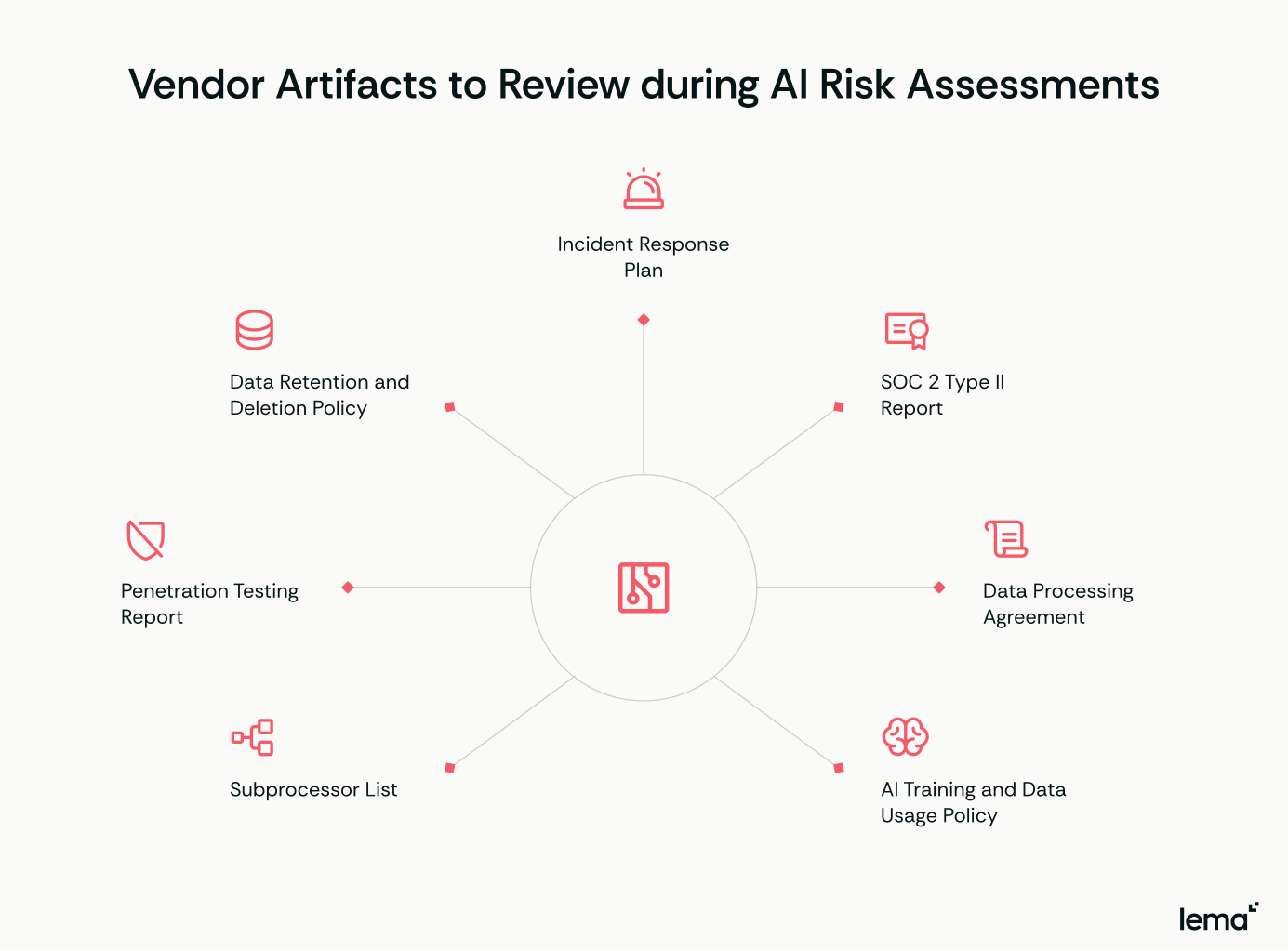
Don’t rely solely on questionnaires, SOC 2 reports, or other artifacts when reviewing AI vendors. Cross-check vendor claims against observable evidence , including disclosed subprocessors, AI product documentation, retention terms, and model training policies.
If a vendor says customer data is not used for training, verify whether that protection is contractual or merely marketing language. Teams should also verify that the vendor's current AI functionality matches what was originally assessed during procurement , as AI capabilities, features, and data-handling practices can change over time.
2. Replace Blanket Questionnaires With Targeted Requests
Use advanced tools to first review submitted artifacts, identify the actual gaps, and then issue focused follow-up questions tied directly to the vendor’s AI usage. If documentation does not clearly explain data retention or subprocessors, ask specifically about those areas. This approach reduces unnecessary back-and-forth while producing far more useful operational context for governance teams reviewing high volumes of AI vendors.
Instead of relying solely on blanket questionnaires or vendor attestations, Lema uses Forensic AI Assessment to analyze certifications, trust center materials, questionnaire responses, and other vendor-submitted artifacts before governance teams issue targeted clarification requests.
Combined with OSINT Recon and Blast Radius Mapping, teams can validate vendor claims against external intelligence and actual organizational exposure , helping surface scope drift, hidden AI dependencies, undisclosed subprocessors, and operational risks that point-in-time assessments often miss.
3. Reassess Vendors When Their AI Scope Changes
Create mandatory reassessment triggers for operational changes that materially affect exposure. Governance teams should also monitor for changes in model providers, infrastructure environments, or newly introduced subprocessors , as these changes can significantly alter operational and regulatory exposure without clear visibility.
AI Data Governance and Privacy Controls
4. Create Clear Rules for What Employees Can Upload to AI Tools
Define exactly which categories of information employees can and cannot share with external AI systems. Customer records, source code, legal contracts, and financial reports should all have clear handling rules tied to approved tools and workflows.
Governance teams should also provide employees with approved alternatives for common AI use cases , because vague restrictions without usable workflows often drive shadow AI adoption instead of reducing it.
5. Disable Model Training on Organizational Data
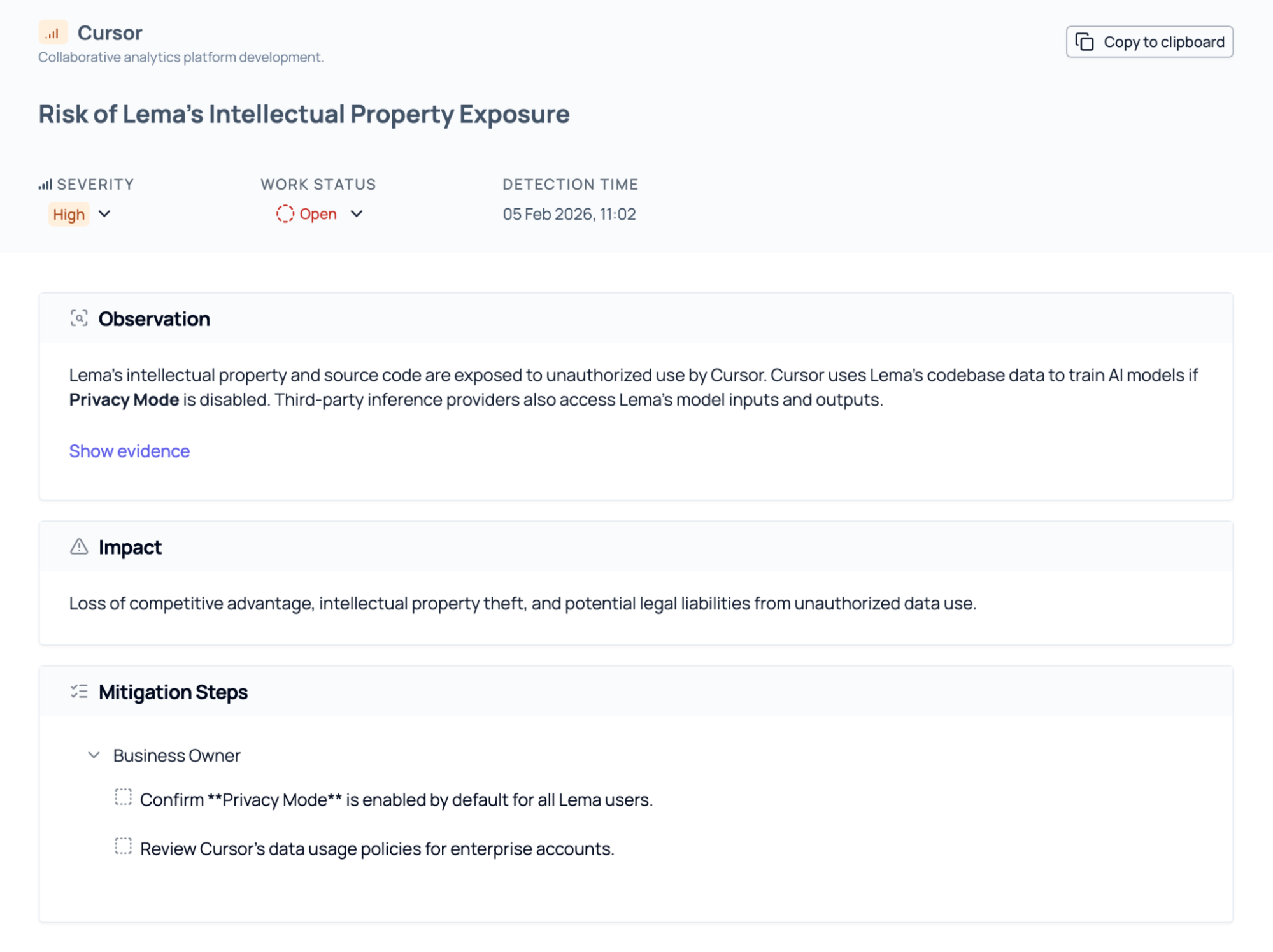
Organizations should verify whether an AI vendor can reuse prompts, uploaded artifacts, generated outputs, API interactions, or other customer content for model training . However, governance teams should not stop there. Many AI tools are deployed with insecure defaults that prioritize vendor analytics, model improvement, or product telemetry over customer confidentiality.
For example, some AI developer tools collect code context, repository content, editor activity, or interaction history by default unless administrators explicitly opt out. Enterprise controls that disable model training, data retention, telemetry collection, or broad content-sharing settings should be reviewed and enabled before deployment . Security teams should treat these configurations as part of the vendor assessment process rather than assuming the most secure settings are enabled out of the box.
The goal is to identify and remediate default configuration risks before the AI tool is introduced into business workflows.
6. Map How Data Moves Through AI Ecosystems
Document where data travels after upload. Governance teams should understand who processes the data, where it is stored, and how long it is retained. This visibility becomes especially important when AI workflows involve multiple hidden third parties operating across different cloud regions or regulatory jurisdictions.
Security & Cyber Risk
7. Limit AI Permissions From the Start
Grant AI vendors the minimum level of access required for their intended business function. Avoid broad workspace permissions, unrestricted repository access, or default access to sensitive systems unless operationally necessary. Governance teams should also review OAuth scopes and connected application permissions during deployment, as many AI tools request far broader access than their actual use cases require.
8. Map the Blast Radius Before Deployment
Before approving an AI vendor, identify which systems could be affected if the tool were compromised or misconfigured. Blast Radius Mapping helps organizations understand operational impact before deployment. This analysis should include downstream operational dependencies as well, particularly when AI tools integrate into customer-facing systems, production environments, sensitive internal workflows, or critical infrastructure.
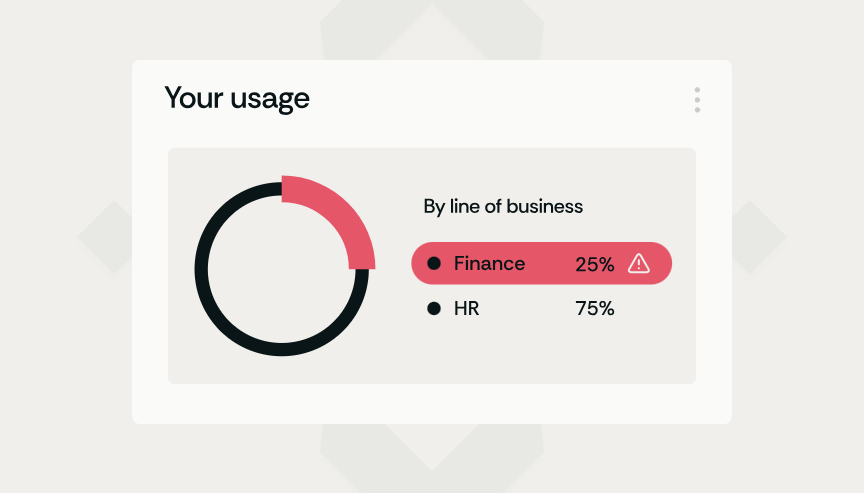
Lema’s Blast Radius Mapping analyzes how third-party AI vendors are actually used across the organization , including which systems they connect to, the level of access they have, who can access them, and how deeply they are embedded in operational workflows. With this unfiltered view, governance teams understand the actual organizational impact a vendor could create if the access scope changes.
9. Monitor Access Expansion Continuously
Review whether AI vendors have expanded beyond their original approved scope. New integrations, additional user groups, or broader workflow dependencies can materially increase operational exposure over time. Connect these reviews to IAM and SaaS management systems so governance teams can automatically detect scope drift.
AI Risk Assessment and Operational Oversight
10. Monitor External Risk Signals Continuously
Don’t depend on vendors to self-report meaningful security or operational changes. Build third-party risk monitoring around external signals that can materially affect vendor exposure , including breach disclosures, exposed assets, litigation, public vulnerabilities, adverse media, and major infrastructure changes. Define escalation logic in advance so that critical events automatically trigger reassessment instead of becoming another ignored alert.
11. Prioritize Remediation Based on Blast Radius
Rank findings based on factors such as access scope, data sensitivity, workflow dependency, and potential business disruption if the AI system were compromised or misconfigured. Then, prioritize remediation based on operational impact and blast radius.
Lema’s Agentic Risk Engineering correlates vendor artifacts, external intelligence, and organizational usage context into clear risk insights that teams across security, procurement, compliance, and leadership can easily understand. Instead of overwhelming teams with noisy findings, governance teams receive actionable mitigation guidance focused on the risks that could materially impact the business.
12. Connect Governance Workflows to Operational Systems
Connect your governance workflows to IAM, SaaS management, procurement, security systems, and IT operations analytics to validate which access vendors actually receive after deployment. If an AI vendor suddenly gains broader repository access, governance teams should see that operational change immediately.
AI Governance Policies and Accountability
13. Create AI Acceptable-Use Policies Employees Can Follow
Write AI policies around actual employee workflows instead of broad legal restrictions. Specify which AI tools employees can use, which types of data they cannot upload, when teams must involve security or legal review, and which workflows require additional approval before AI tools are introduced.
Additionally, provide employees with approved alternatives for common AI tasks so teams do not bypass governance processes to remain productive. Clear operational guidance reduces shadow AI far more effectively than vague policy language.
.svg)
14. Require Human Review for High-Impact AI Workflows
Don’t allow AI systems to make fully autonomous decisions in workflows that create significant legal, financial, security, or operational consequences, such as approving payments or blocking customer accounts. Define exactly where human intervention must occur inside the workflow and assign accountability to specific teams or roles. Governance teams should also document escalation paths for situations where AI outputs appear unreliable, inconsistent with policy, or potentially harmful to the business.
To reduce operational exposure and improve visibility into evolving AI vendor risk, governance teams should take incremental steps to strengthen monitoring, oversight, and reassessment processes over time. Here’s what you can do this quarter:
Now
- Add five AI-specific questions to your next vendor review process
- Ask your top vendors which AI tools they use internally and how those tools handle organizational data
30–60 Days
- Create an “AI vendor” tier within your vendor classification framework
- Define what “silent failure” means for AI vendors within your risk register
- Establish contractual disclosure expectations for model updates, new subprocessors, and material AI functionality changes
This Quarter
- Map blast radius for vendors with AI in the data path
- Set up lightweight monitoring triggers for AI adoption and scope drift signals
- Run a tabletop exercise around a silent AI failure scenario involving a critical vendor
The Future of AI Governance Is Risk Engineering
Modern AI governance needs to shift to a risk-engineering approach, becoming more operational, continuous, and evidence-driven. To establish clear, future-proof AI governance, organizations need visibility into how AI is actually used across the business, which systems and data it can access, where exposure is expanding, and which risks require immediate action rather than another annual review cycle.
Lema transforms governance and TPRM teams into Risk Engineers capable of uncovering the risks traditional programs miss. It validates vendor claims against observable evidence, maps operational blast radius, monitors continuous risk signals, and uncovers hidden exposure across third-party AI ecosystems, giving teams a far more realistic understanding of where AI risk actually exists. Moreover, teams receive clear, actionable recommendations to detect and prevent AI risks from third-party vendors effectively.
Think outside the checkbox. Book a demo to see the risks that questionnaires and vendor attestations don’t surface.
