
Vendor Risk Assessment: Requirements & Components


Security teams are now responsible for reviewing hundreds, sometimes thousands, of SaaS platforms, AI tools, contractors, cloud providers, and strategic partners. Yet many vendor risk assessment programs still rely on point-in-time reviews and spreadsheets, even though both vendor posture and organizational exposure change continuously.
The problem is not just the number of vendors or the sensitivity of the data they can access. Vendor security posture changes over time, while vendor scope often expands between assessments as access, integrations, and usage grow. Organizations need to validate both continuously.
Vendor risk assessments are now a core security function, but they need to move beyond questionnaires and vendor attestations. Effective programs continuously validate vendor claims, identify changes in vendor posture and organizational exposure, and quantify the potential business impact of a vendor failure.
What Is a Vendor Risk Assessment?
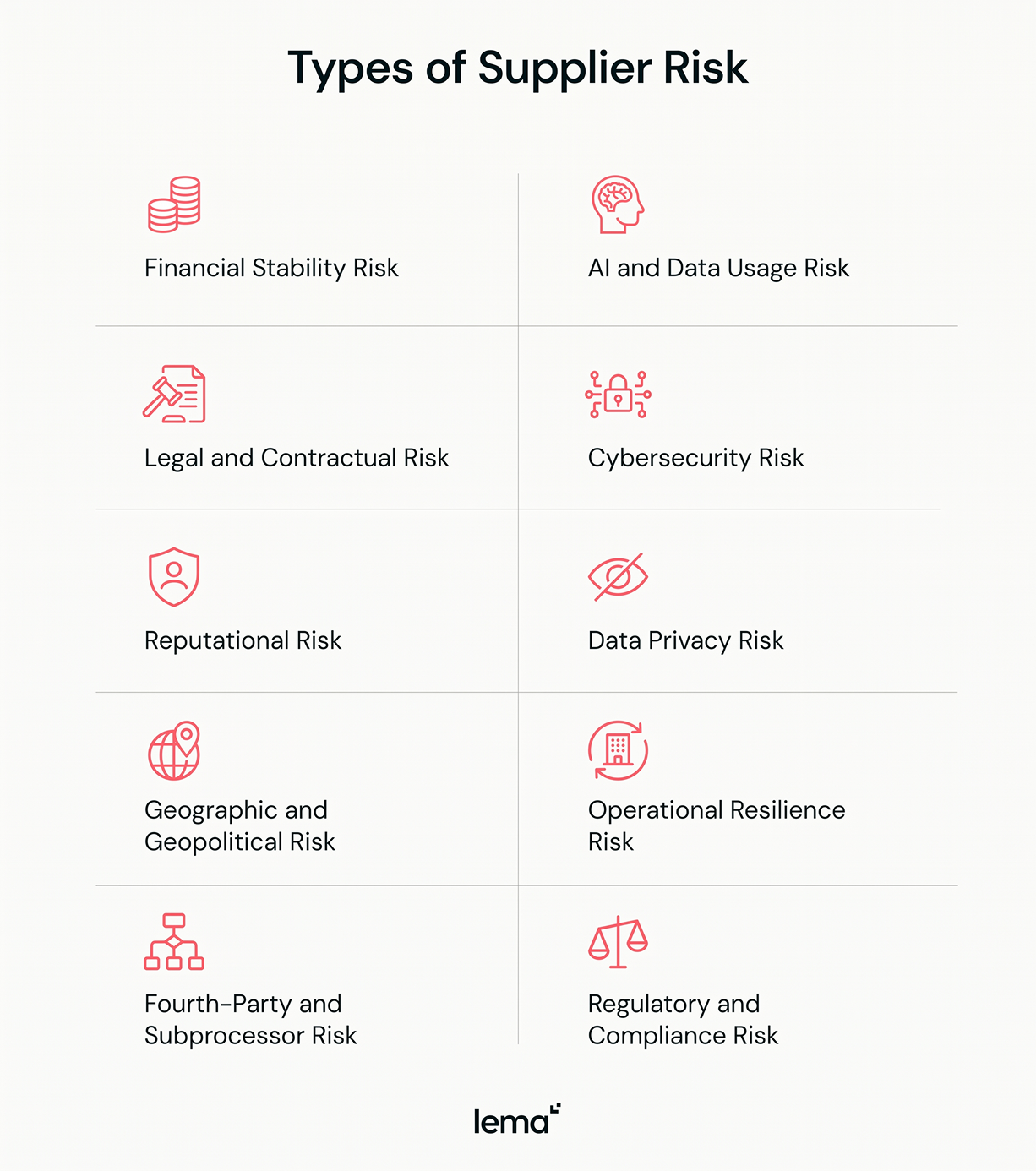
A vendor risk assessment is the process of evaluating the security, operational, legal, regulatory, and business risks introduced by a third party before and throughout the relationship . Most assessments are built around a questionnaire and a collection of vendor artifacts, such as certifications, policies, audit reports, and other supporting documentation.
Modern GRC automation and specialized vendor risk assessment platforms go further by using AI to analyze those artifacts, independently validate vendor claims, incorporate business context such as the vendor's level of access and organizational exposure, and collect ongoing external risk signals . They provide a more accurate understanding of the risks a vendor could introduce than questionnaires and submitted documentation alone.
This evolution is increasingly important as organizations rely on an expanding ecosystem of SaaS providers, cloud services, AI platforms, contractors, and managed service providers. At the same time, third-party incidents continue to rise. According to Verizon's Data Breach Investigations Report (DBIR), approximately 48% of breaches involve a third party. Vendor risk assessments must therefore address not only cybersecurity, but also operational resilience, data privacy, business continuity, and emerging AI risks, such as unauthorized use of sensitive data, insecure model integrations, and AI providers with broad access to proprietary information.
What Questions Should a Vendor Risk Assessment Answer?
A mature vendor risk assessment should determine a vendor's inherent risk , security posture , and blast radius (the scope of access, data exposure, and potential business impact if the vendor were compromised). Key questions include:
Inherent risk
- What data will the vendor access, process, or store?
- Will the vendor connect to internal systems, APIs, cloud environments, or production infrastructure?
- Is the vendor operationally or commercially business-critical?
- Which regulations, contractual obligations, or compliance requirements apply to this relationship?
- How is AI functionality handling organizational or customer data?
Vendor security posture
- Has the vendor experienced breaches, lawsuits, or other adverse security events?
- Does the vendor rely on subprocessors or fourth parties?
- What security controls and supporting artifacts demonstrate the vendor's security practices?
Blast radius
- How exactly is the vendor accessing internal environments?
- Who inside the organization uses the vendor?
- Has the vendor's access or scope expanded since onboarding?
- What would happen if the vendor experienced an outage or security incident?
Vendor Risk Assessment Requirements: What Every Program Needs
1. Vendor Inventory
Every vendor assessment starts with strategic visibility. You cannot assess risk accurately if you do not know which vendors exist inside the organization. And that’s not just sanctioned vendors, but shadow IT, SaaS platforms, contractors, subprocessors, and AI tools acquired outside procurement workflows. Many organizations still manage vendor data across disconnected spreadsheets, procurement systems, and business-unit records, creating blind spots. While risk scores are assigned to individual vendors, an incomplete inventory creates a much larger problem : vendors that are never identified are never assessed, leaving gaps that can undermine the organization's overall security posture.
V endor ecosystems also change constantly. A vendor approved for a single limited use case can gradually become deeply integrated into business-critical workflows without triggering a reassessment. Mature TPRM programs maintain a centralized inventory that tracks ownership, approved scope, lifecycle stage, renewal dates, data exposure, operational dependency, and assessment status.
2. Inherent Risk Based on Business Context
Traditional TPRM programs often rely heavily on business-owner-defined assumptions about inherent risk. The problem is that business owners do not always understand how deeply integrated a vendor becomes over time or how exposure evolves after onboarding .
Modern risk programs increasingly look beyond vendor questionnaires and stated use cases to evaluate both vendor posture and organizational blast radius. Risk becomes far more meaningful when organizations understand both how secure a vendor is and what could happen if that vendor fails.
Not every vendor requires the same level of assessment depth. For example, a payroll provider connected to HR systems introduces very different risks than a low-impact scheduling tool. Effective risk tiering evaluates data sensitivity, operational dependency, system access, geographic exposure, regulatory obligations, and business criticality.
It should also consider the sensitivity and criticality of the information a vendor can access, including credentials, financial records, intellectual property, and customer data, as well as how dependent different business units are on the vendor. Organizations need to understand how disruptions would affect internal operations.
3. Evidence Collection and Validation
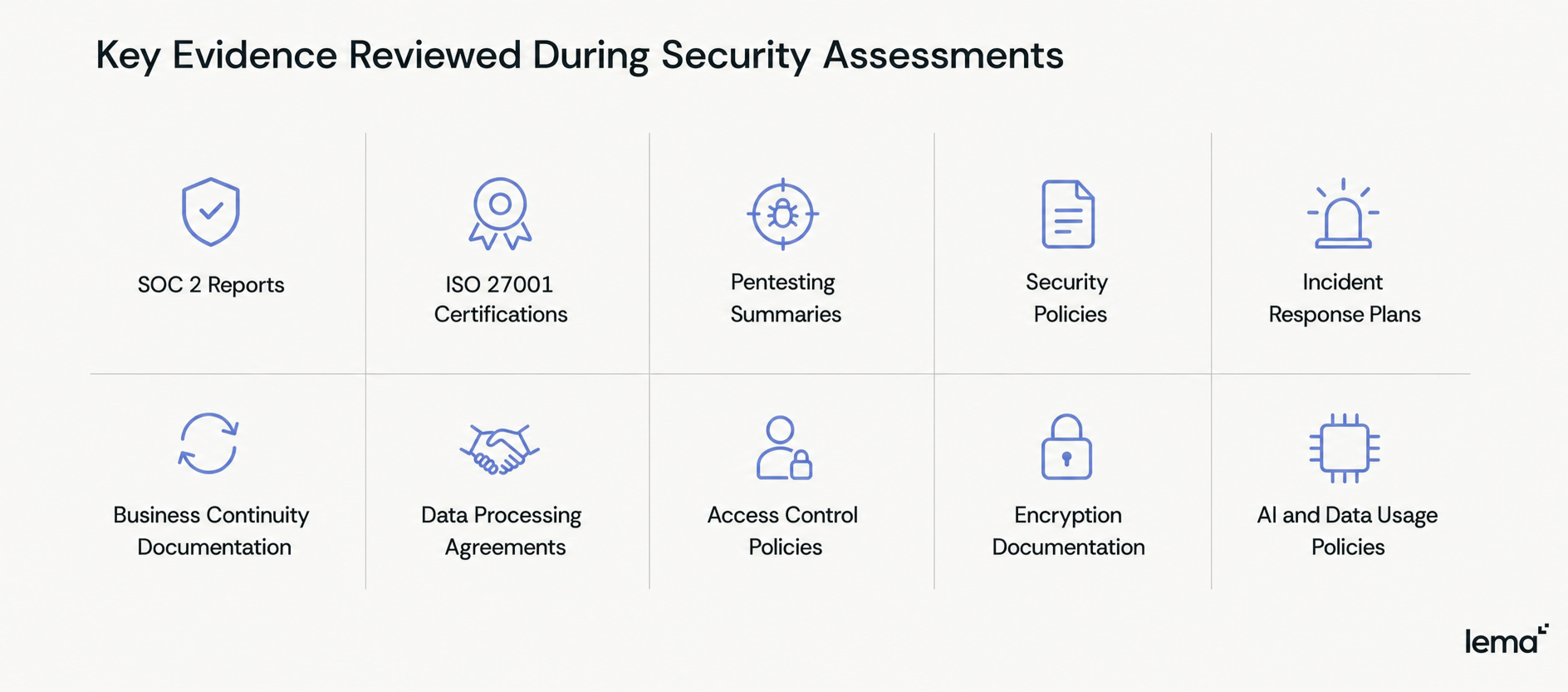
Evidence collection is one of the most misunderstood areas of a supplier risk assessment . Many programs still treat certifications, questionnaires, and vendor-provided reports as proof of security posture. However, certifications may be outdated, narrowly scoped, incomplete, or disconnected from how the vendor actually operates.
Teams should review evidence for scope gaps, missing controls, expired certifications, and inconsistencies. Mature TPRM programs issue targeted evidence requests based on detected gaps and relationship context.
Lema’s Enterprise Supply Chain Security platform approaches vendor risk as an evidence-and-exposure problem rather than a workflow exercise. Its Forensic AI Assessment analyzes vendor-submitted artifacts and applies automated control validation to identify missing controls, inconsistencies, and evidence gaps. When additional validation is required, Smart Evidence Requests automatically issue evidence-backed clarification requests, allowing vendors to confirm findings or provide contextual explanations.
4. Security and Privacy Control Review
Control reviews should reflect the vendor’s actual level of exposure to the business. A mature assessment evaluates practical security and privacy controls, such as:
- Authentication and MFA enforcement
- Encryption standards
- Vulnerability management
- Logging and detection capabilities
- Backup and recovery procedures
- Incident response processes
- AI data handling practices
The objective is to determine whether the control is appropriate for the vendor’s level of organizational access and operational impact. For example, a vendor processing regulated healthcare or financial data should undergo much deeper scrutiny around encryption, retention, detection, and recovery capabilities than a low-impact productivity platform.
5. Contractual and Regulatory Requirements
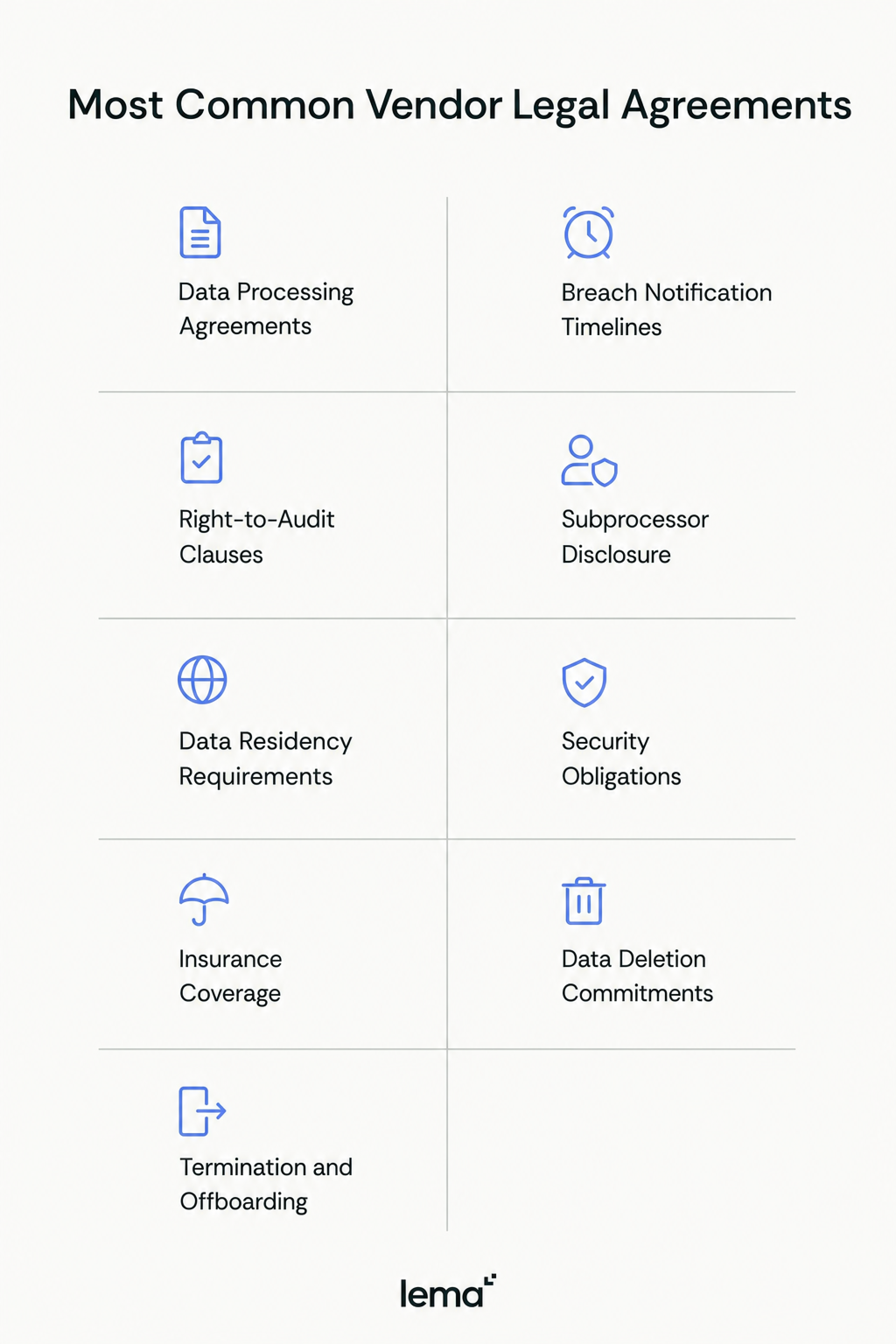
Vendor risk assessments should confirm that contractual commitments match the vendor’s actual security and operational practices. Reviews typically cover areas such as breach notification timelines, data processing agreements, audit rights, and data deletion responsibilities to ensure accountability can be enforced when issues arise.
Assessments should also evaluate alignment with applicable laws and regulations, such as GDPR, HIPAA, DORA, or NIS2, as well as relevant standards or assurance frameworks such as ISO 27001, SOC 2, or PCI DSS.
6. Continuous Monitoring
Vendor risk does not remain static after onboarding. A vendor's security posture can change due to newly disclosed vulnerabilities, security incidents, product updates, ownership changes, or other external developments. At the same time, the organization's relationship with that vendor can evolve as it gains access to additional systems, data, users, integrations, or business processes.
Strong vendor risk programs continuously evaluate both the vendor's external risk signals and changes in the organization's exposure. The goal is to detect changes in vendor posture, identify scope drift caused by expanding access or new products and features, and understand how those changes affect the vendor's overall risk before they lead to a security or operational incident.
Core Components of an Effective Vendor Risk Assessment
The requirements above define what a mature vendor risk program needs to function properly: visibility, contextual risk analysis, evidence validation, ongoing oversight, governance, and remediation. The components below describe how those capabilities are applied operationally throughout the assessment process itself, from initial vendor intake through offboarding.
1. Vendor Request
The assessment process begins when the business submits a request for a new vendor. Security and risk teams collect the information needed to understand the relationship before the review begins, including the intended use case, the systems involved, requested integrations, potential exposure of sensitive data , the business owner, and operational dependencies. That intake information establishes the context for every subsequent stage.
2. Inherent Risk Assessment
Once intake is complete, teams assess the vendor's inherent risk before reviewing controls or documentation. The purpose of this stage is to understand the baseline exposure introduced by the relationship and use that information to determine the appropriate assessment type, assessment scope, control requirements, and level of due diligence.
Traditionally, organizations rely heavily on information provided during vendor intake and business-owner-defined assumptions about how the vendor will be used. However, these assumptions are not always accurate and can become outdated as vendor relationships evolve. A more robust approach considers both the vendor's security posture and the organization's actual exposure , including the systems, data, users, and business processes the vendor can access.
Teams typically evaluate factors such as the sensitivity and criticality of accessible data, system permissions, integration points, business dependency, operational impact, geographic exposure, and regulatory obligations. Together, these factors help determine not only how extensively the vendor should be assessed, but also the potential business impact if the vendor were compromised.
3. Due Diligence and Evidence Review
Once inherent risk has been established, organizations determine the appropriate level of due diligence based on the vendor’s risk profile . Higher-risk vendors typically require deeper reviews, broader evidence collection, and more extensive control validation than low-risk vendors. Security teams review vendor-submitted artifacts to evaluate whether the vendor’s controls align with the level of exposure identified during intake and inherent risk assessment. Any gaps, missing evidence, inconsistencies, or areas requiring clarification are documented for follow-up.
4. External Intelligence Review
Organizations should evaluate publicly available intelligence , including disclosed breaches, vulnerabilities, adverse media coverage, lawsuits, sanctions, and trust center updates, that may affect the vendor's risk profile.
This review is most effective when combined with independent validation of vendor claims. Rather than accepting vendor-provided artifacts at face value, mature programs analyze documentation, policies, and reports to identify gaps, inconsistencies, or risks that may not be explicitly disclosed .
Lema supports this through its Forensic AI Assessment and OSINT Recon capabilities. Its Forensic AI Assessment analyzes vendor artifacts and cross-references claims against available evidence. At the same time, OSINT Recon continuously collects and analyzes external intelligence to surface relevant security, operational, and reputational risk signals.
5. Blast Radius Analysis
Blast radius analysis evaluates the potential organizational impact if a vendor is breached or goes offline. Blast radius refers to the scope of a vendor’s access, integrations, internal usage, sensitive data exposure, and operational dependencies within the environment, helping organizations understand not just how risky a vendor may be, but also how exposed they would be if that vendor were breached, unavailable, or otherwise disrupted.
The same vendor can create different exposure depending on how the organization uses it. Lema’s Blast Radius Monitoring helps organizations analyze that exposure by mapping how vendors interact with systems , providing a clearer understanding of potential business impact.
6. Risk Scoring and Prioritization
Once assessment findings are collected, teams must determine which issues require action before approval or onboarding can proceed. Effective prioritization goes beyond counting findings or assigning generic risk scores. It considers both vendor posture and blast radius, including the vendor’s level of access, the sensitivity of the data involved, operational dependency, and the potential business impact if a control fails.
Findings involving vendors with extensive access to critical systems, sensitive information, or business-critical processes typically require greater attention than similar issues in low-impact relationships. The goal is to focus remediation efforts on the risks most likely to create meaningful organizational exposure.
7. Remediation and Follow-Up
The goal of a vendor risk assessment is not just to identify risk, but to reduce organizational exposure. Once findings have been prioritized, teams should determine the most appropriate remediation actions based on the vendor's posture and blast radius . Depending on the issue, this may involve implementing a vendor risk mitigation plan, strengthening contractual protections, changing configurations, revoking unnecessary permissions or OAuth grants, restricting access, or requiring the vendor to address identified gaps. Some actions require engagement with the vendor, while others involve business owners, IT teams, or SecOps teams responsible for managing operational exposure.
8. Ongoing Lifecycle Management
Vendor risk management continues throughout the relationship lifecycle. Expanded access, new integrations, or operational changes may trigger periodic assessments. When vendors are offboarded, teams should also verify the revocation of access, the removal of integrations, and the deletion of data to ensure organizational exposure is fully closed.
Vendor Risk Assessment Checklist for Modern TPRM Team
A modern vendor risk assessment program should:
- Maintain a centralized inventory of vendors and third-party tools.
- Identify what systems, APIs, environments, workflows, and data each vendor can access.
- Tier vendors based on inherent risk, organizational exposure, and business criticality.
- Validate certifications, reports, policies, and questionnaire responses.
- Compare vendor claims against external intelligence and publicly observable activity.
- Use targeted, automated follow-up requests to clarify identified gaps.
- Review authentication, encryption, logging, detection, incident response, and other relevant security controls.
- Assess AI data handling, subprocessors, data retention practices, and privacy obligations where applicable.
- Prioritize remediation based on vendor security posture and blast radius.
- Reassess vendors when access, usage, integrations, dependencies, or other aspects of the relationship change.
- Validate offboarding by confirming access revocation and the secure deletion of data.
It’s Time to Stop Treating Vendor Risk Like Paperwork
A mature vendor risk assessment program should do more than collect questionnaires and documentation. It should help organizations understand their actual exposure, prioritize the risks that matter most, and take action to reduce them. That requires combining evidence validation, external intelligence, blast-radius visibility, and continuous monitoring to understand not just how risky a vendor appears to be, but also how the organization would be impacted if that vendor were compromised, unavailable, or operating outside its approved scope.
Lema helps organizations move beyond checkbox-driven TPRM by combining Forensic AI Assessment, OSINT Recon, Blast Radius Monitoring, and Continuous Risk Signal Collection to uncover risks that traditional assessments frequently miss. Its Agentic Risk Engineering layer correlates vendor artifacts, external intelligence, and organizational exposure into prioritized, evidence-backed remediation.
Instead of treating vendor assessments as compliance paperwork, Lema helps teams operate like Risk Engineers: verifying claims, detecting scope drift, understanding business impact, and reducing exposure before vendor risk becomes operational damage.

FAQs
What Is an Example of a Vendor Risk?
A common vendor risk is an email signature tool that quietly holds full Google Workspace admin rights. Although it appears low risk, those excessive privileges could allow an attacker to take over user accounts, access sensitive data, and disrupt business operations if the vendor is compromised.
What Are the 5 Steps of RM?
A common simplified risk-management model includes risk identification, assessment, mitigation, monitoring, and review. Different frameworks use different terms and step counts.
What Information Is Required for a Vendor Risk Assessment?
Organizations typically collect information about the vendor's services, data access, integrations, security controls, certifications, policies, subprocessors, compliance obligations, and business use cases to understand potential risk.
Who Is Responsible for Vendor Risk Assessments?
Vendor risk assessments are usually managed by third-party risk management (TPRM), security, GRC, or procurement teams, with input from the business owner and IT stakeholders.
