
What Is Shadow AI?
%201.svg)
Most organizations already have Shadow AI embedded across their business. Employees are uploading contracts into ChatGPT, and departments are adopting AI tools or enabling new AI capabilities inside already approved vendors, long before security or procurement teams review them. Meanwhile, many organizations are still relying on point-in-time assessments that cannot keep pace with the rapid spread of AI across the business.
Microsoft’s 2026 Work Trend Index shows that employee AI adoption is outpacing organizational readiness. Only 19% of AI users say those two are aligned. Shadow AI is no longer just another version of Shadow IT. These systems interact directly with sensitive workflows, internal artifacts, source code, customer information, and operational decision-making.
Most organizations do not fully understand what access these AI tools and vendors with newly introduced AI capabilities have, how their usage changes over time, or what the operational impact would be if those vendors were compromised. Many traditional TPRM tools don’t support this level of continuous, fast-changing exposure.
Shadow AI Explained
Shadow AI refers to AI tools used inside an organization without formal security, procurement, or vendor risk approval. Most people think this just means employees using ChatGPT, but the problem is much broader than that.
Common examples include AI features activated inside already-approved SaaS platforms, AI coding assistants connected to production environments, employees using personal AI accounts for work, or departments onboarding AI-enabled vendors without security review or a formal supplier risk assessment . In many cases, the vendor itself was already approved years earlier, but new AI capabilities were introduced later without a reassessment of the resulting exposure.
Unlike traditional Shadow IT, AI tools interact directly with sensitive business operations, internal knowledge, and operational decision-making rather than simply sitting alongside existing infrastructure. For example:
- A developer using an unauthorized AI coding assistant may expose proprietary code and internal repositories
- A legal team uploading contracts into a public GenAI platform may expose confidential agreements and negotiation strategies
- A marketing department using AI tools on or with customer information may create compliance and regulatory exposure without fully understanding how that information is processed, retained, or reused
- A business team enabling AI functionality inside an approved CRM or knowledge management tool may significantly expand how sensitive artifacts are processed without triggering a new vendor review
Therefore, Shadow AI creates a far more complex risk profile than traditional unsanctioned software adoption.
.svg)
Why Is Shadow AI Getting Out of Control?
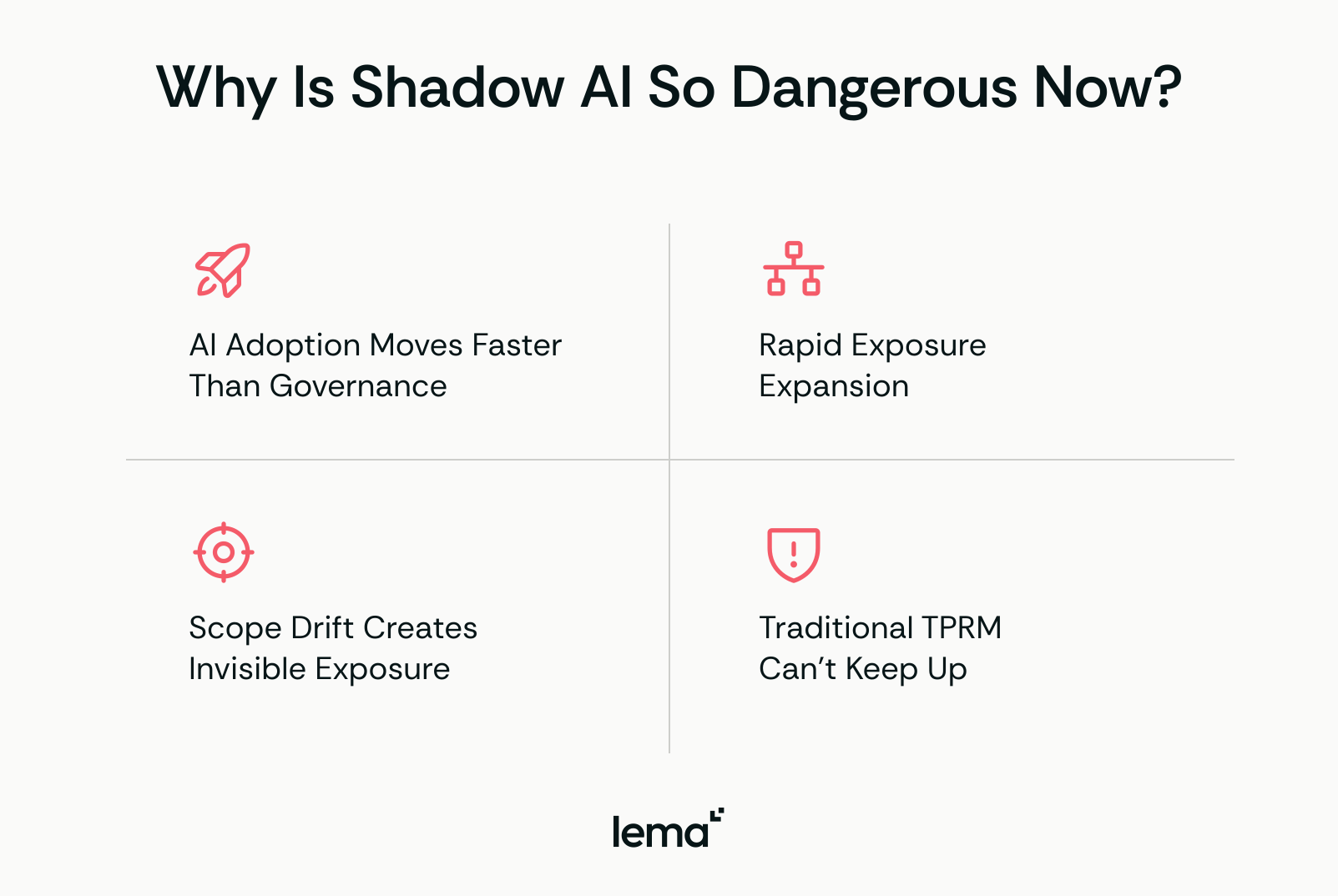
1. AI Adoption Now Moves Faster Than Governance
Most procurement and vendor governance processes are effective for a slower world where vendors moved through formal review before gaining access to sensitive systems or organizational artifacts. AI adoption does not work that way. Employees can discover, test, onboard, and operationalize AI tools in hours without involving procurement, security, or compliance teams. As a result, organizations often discover AI vendors long after those tools are already embedded in operational workflows.
2. AI Exposure Expands Rapidly After Onboarding
AI exposure rarely stays contained to the original use case. A tool introduced for simple experimentation can quickly spread across departments once employees see productivity gains. Over time, AI tools often gain broader access and become tied to more sensitive workflows across the organization. A vendor approved for a limited use case can quietly become critical to day-to-day operations long before anyone reassesses the exposure.
3. Scope Drift Creates Invisible Exposure
Scope drift happens when a vendor’s real-world usage expands beyond the originally approved purpose or access assumptions. AI environments create constant scope drift because successful tools naturally spread across teams and workflows over time. That directly affects blast radius - the scope of systems, workflows, users, artifacts, and business operations affected if a vendor is compromised. A larger blast radius means a larger organizational exposure.
AI-enabled features inside approved vendors are often a major source of scope drift because they change how information is processed, accessed, and shared without changing the vendor relationship itself.
4. Traditional TPRM Can’t Keep Up
Most traditional TPRM programs still rely heavily on business owner-defined inherent risk and point-in-time assessments. Those assumptions become outdated almost immediately in dynamic AI environments.
A questionnaire completed six months ago does not explain:
- How the tool is actually being used today
- Whether tool usage expands beyond the original approved users
- What sensitive data employees are inputting
- What business impact the vendor's failure would create
Shadow AI is not simply a policy issue or an employee behavior problem. Organizations are dealing with continuously evolving third-party exposure that traditional tools were never designed to understand. This is particularly challenging when AI-powered applications and AI models become embedded in business workflows long after the original vendor review was completed.
The Biggest Risks Hidden Inside Shadow AI
Sensitive Data Exposure
Employees routinely upload sensitive organizational data into AI systems without understanding how that information is processed or reused. They may upload contracts, source code, customer information, and internal documentation. Personal AI accounts make this even more difficult to govern because enterprise controls often do not apply outside approved environments. Once AI adoption becomes normalized inside the business, sensitive data exposure spreads far faster than most organizations expect.
Compliance and Regulatory Exposure
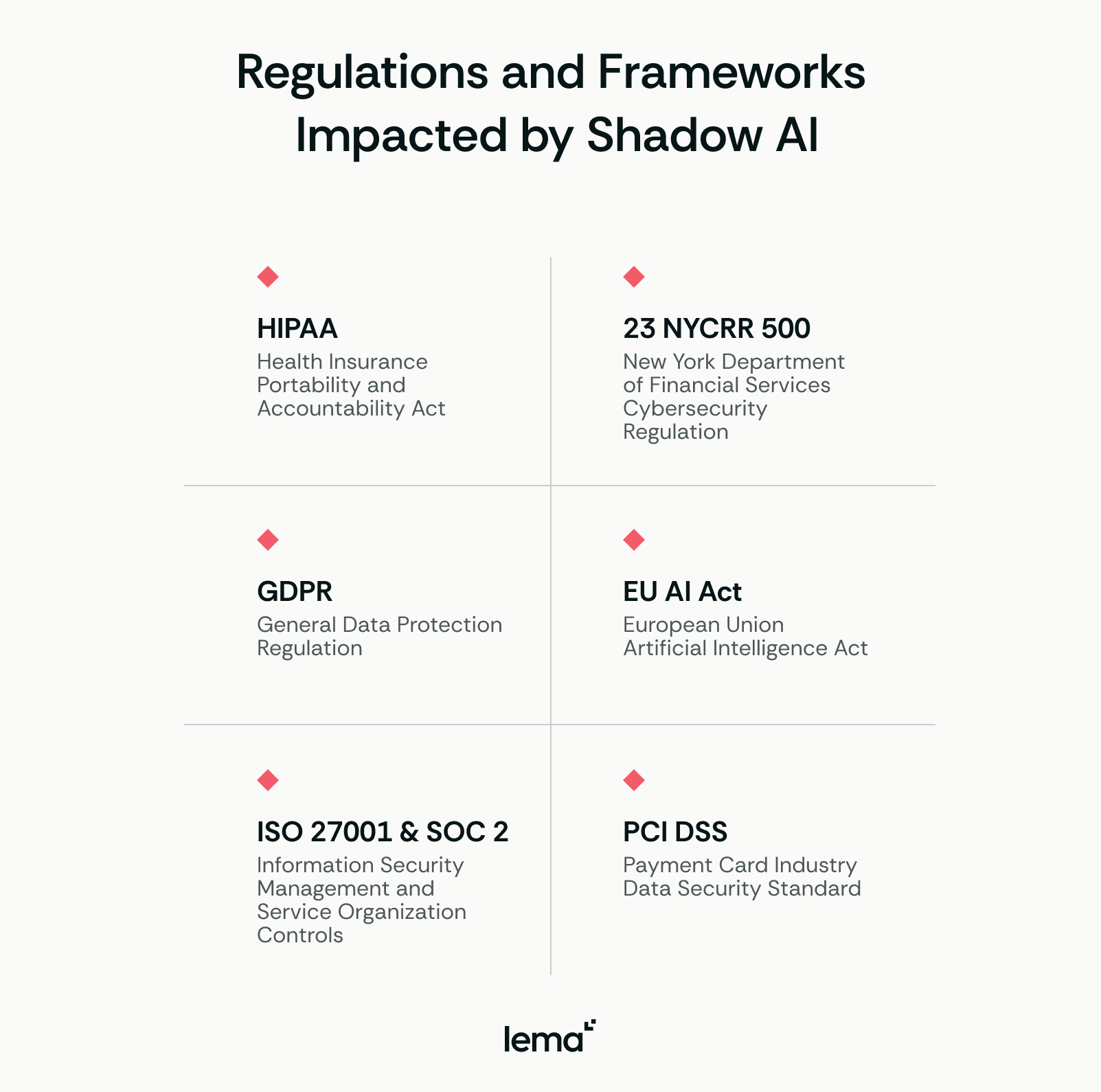
Shadow AI creates immediate compliance and governance challenges for organizations operating under regulations such as GDPR and HIPAA, as well as assurance or industry standards such as SOC 2 and PCI DSS. Data residency becomes difficult to control when employees upload sensitive artifacts into public AI systems. Auditability weakens when AI-driven workflows operate outside approved governance channels. Organizations may also lose visibility into how customer information is processed, retained, transferred, or accessed across AI ecosystems.
How to Reduce Shadow AI Risk Without Slowing Innovation
1. Replace Blanket AI Bans With Controlled Enablement
Organizations that attempt to ban AI entirely usually push adoption further underground. Employees continue using AI tools because the productivity gains are immediate and operationally valuable. A more effective approach is controlled enablement. Establish approved AI usage pathways, define acceptable use policies, clarify which artifacts cannot be uploaded into external systems, and provide employees with secure, vetted alternatives. This approach reduces unsanctioned adoption while enabling the business to benefit from AI safely.
2. Maintain Visibility Into AI Capabilities Across Your Vendor Ecosystem
AI risk often emerges inside vendors that were already approved long before AI functionality was introduced. A collaboration platform, CRM, design tool, or productivity suite can add AI features that change how information is processed, retained, accessed, or shared . Organizations need visibility into which vendors have introduced AI capabilities, where those capabilities are being used, who is using them, and how they affect existing security and governance assumptions.
3. Understand Blast Radius When Vendors Introduce AI Functionality
When a vendor introduces new AI capabilities, organizations should reassess the blast radius associated with that vendor relationship. Features that appear low risk may gain access to sensitive artifacts, business workflows, customer information, or operational processes that were never considered during the original review. Understanding the scope of access, data exposure, and potential business impact allows teams to determine whether the vendor's risk profile has materially changed and develop a more sustainable vendor risk management strategy.
4. Detect Unsanctioned AI Usage and AI Capability Adoption
Organizations need visibility into both unsanctioned AI tools and AI capabilities being adopted inside approved vendors. Employees may begin using newly released AI assistants, copilots, summarization features, or content-generation capabilities without any additional security review. The earlier organizations identify these changes, the easier it becomes to evaluate exposure, understand blast radius, and prevent unreviewed AI functionality from becoming embedded in critical workflows.
5. Continuously Collect Risk Signals Around AI Vendor Usage
A vendor approved during onboarding can look completely different six months later. New AI capabilities, integrations, permissions, and workflows can significantly expand organizational exposure beyond what was originally assessed. Security teams need ongoing third-party risk monitoring to understand how vendors evolve after introducing AI capabilities.
Lema combines Continuous Risk Signal Collection, OSINT Recon, and Blast Radius Monitoring to help organizations understand how AI vendors evolve after onboarding. The platform continuously analyzes external intelligence alongside real organizational usage patterns to surface scope drift, shadow AI adoption, and expanding vendor access before those changes create meaningful business risk.
6. Validate Vendor Claims Against External Intelligence
Do not rely solely on vendor announcements, release notes, trust center updates, or questionnaire responses when vendors introduce new AI functionality. Security teams should review publicly available documentation, data processing terms, AI policies, disclosed subprocessors, and reported security incidents to determine whether the vendor's actual practices align with its stated claims.
Lema’s OSINT Recon continuously collects and analyzes publicly available intelligence , including disclosed breaches, vulnerabilities, adverse media, trust center updates, and external security signals. The platform cross-references those claims against observable evidence and relationship context to surface the risks that questionnaires and attestations fail to reveal.
7. Reassess Vendors When AI Capabilities Materially Change Risk
Many organizations focus on reviewing new AI vendors while overlooking AI functionality added to approved vendors. Security and risk teams should establish a process requiring business owners and vendor owners to notify them when existing vendors introduce AI assistants, copilots, content-generation features, summarization tools, or other AI capabilities .
Those changes should trigger a targeted review of data access, retention practices, integrations, permissions, and business impact to determine whether the vendor's risk profile has materially changed. This approach helps organizations identify AI-related scope drift early and prevent unreviewed AI functionality from becoming embedded in critical business processes.
Shadow AI Is Already Part of Your Attack Surface
Shadow AI is already embedded across enterprise environments, often far more deeply than security teams realize. The real danger is the invisible exposure created when organizations continue to rely on outdated TPRM models that cannot continuously verify vendor behavior or the operational impact of vendor failures.
Lema approaches Shadow AI as an exposure and Risk Engineering problem rather than a compliance workflow. The platform combines Forensic AI Assessment, OSINT Recon, and blast-radius visibility to validate vendor claims against reality, continuously collect external intelligence, and understand the real organizational impact a vendor could have if compromised or misused.
Instead of relying solely on questionnaires or security scores, the platform helps organizations surface the AI-related third-party risks that actually matter to the business before they turn into breaches or operational disruptions.

FAQs
What is the Use of Shadow AI?
Employees and departments typically use Shadow AI to improve productivity, automate repetitive work, generate content, analyze information, write code, summarize documents, or accelerate business workflows without waiting for formal IT approval. The problem is that many of these tools are adopted outside security and procurement processes, creating hidden organizational exposure.
How to Detect Shadow AI?
Organizations can detect Shadow AI by identifying unapproved AI tools connected to corporate systems, monitoring third-party integrations, analyzing authentication and usage patterns, and reviewing AI vendors' access across the organization. Continuous risk signal collection and blast radius visibility also help surface scope drift and unsanctioned AI adoption before it creates larger security risks.
Why is Shadow AI a Security Risk?
Shadow AI is risky because employees and teams can introduce AI tools into sensitive workflows without formal security review, vendor diligence, or governance controls. That can expose source code, contracts, customer data, internal knowledge, and operational systems to third-party AI vendors in ways the organization does not fully understand or monitor. The core issue is not just unauthorized tool usage. It is hidden exposure, expanding access, and growing dependency without clear visibility into business impact.
What is Shadow Artificial Intelligence?
Shadow artificial intelligence, or Shadow AI, refers to AI tools, copilots, agents, and AI-enabled SaaS platforms used inside an organization without formal security, procurement, or vendor risk approval. These tools often interact directly with sensitive workflows, internal knowledge, customer information, and operational systems, creating exposure that organizations may not fully understand or control.