
TPRM Process: A Practical Guide to Managing Third-Party Vendor Risk

Most organizations now depend on hundreds, or even thousands, of third-party vendors to operate. These relationships bring capability and speed, but they can also introduce risks that the organization cannot fully control or see. A vendor with access to customer data, a SaaS tool embedded in a critical workflow, or an AI agent processing sensitive documents each represents a point at which the organization's security posture depends on decisions made elsewhere.
As these dependencies multiply, so does the share of breaches that run through them: Verizon's 2026 Data Breach Investigations Report found that 48% of confirmed breaches involved a third party, up from 15% just two years earlier.
The Third-Party Risk Management (TPRM) process exists to close that gap, although it remains one of the most operationally difficult areas of enterprise security. Each stage of the process, from identifying which vendors exist to removing their access once the relationship ends, presents structural challenges that compound over the lifecycle. The rapid adoption of AI tools has added a further layer of difficulty by introducing categories of vendor exposure that most existing processes were not designed to detect.
This article examines the core stages of the TPRM process, considering where each tends to break down in practice and what a more defensible approach involves. Along the way, it addresses how AI adoption is reshaping the vendor landscape, why questionnaire-based assessment continues to fall short, and why closing identified risks often stalls when it depends on vendor cooperation.
{{banner-large-1="/inline-cards"}}
Summary of key TPRM process stages
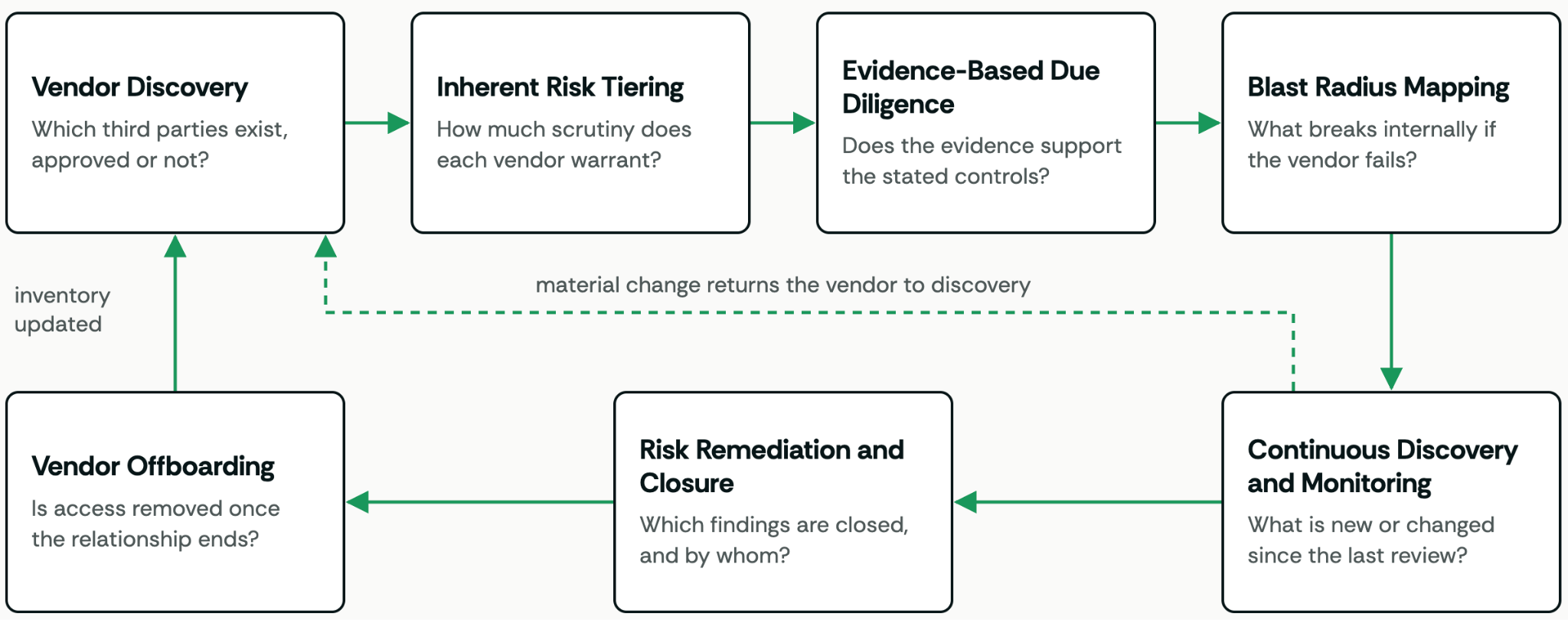
The table below summarizes the seven stages of the TPRM process that this article will explain in detail.
Vendor discovery
The growing use of self-service SaaS and generative AI has made vendor discovery more complex. Employees can adopt new tools without IT, security, or procurement, while existing vendors may introduce AI capabilities that change how the organization processes data. Vendor discovery helps address this risk surface. It is the process of identifying and maintaining an inventory of third parties that access organizational systems, integrate with internal services, or process data on the organization's behalf.
Vendor relationships emerge through multiple channels: business units subscribe to SaaS products, engineering teams integrate APIs and open-source dependencies, and employees adopt AI copilots, browser extensions, and agents. These tools can bypass formal review, creating shadow IT and shadow AI. Even vendors already in the inventory may introduce new risks when product updates change their data flows or introduce external AI services. Without visibility into these relationships, organizations cannot reliably assess vendor risks, enforce contractual requirements, or monitor changes throughout the vendor lifecycle.
A reliable discovery process combines multiple data sources rather than relying on procurement records alone. Identity providers reveal application access and OAuth grants, cloud access security brokers (CASBs) help identify SaaS usage, and endpoint detection and response (EDR) tools provide visibility into installed and running software.
Lema's platform applies this approach by combining approved vendors from procurement and GRC systems with shadow applications and shadow AI identified through read-only integrations with security platforms, including Okta, Microsoft Entra ID, Google Workspace, Wiz, Netskope, and CrowdStrike, as documented by Lema. This broader inventory provides a more complete starting point for subsequent risk assessments and continuous vendor monitoring.
Inherent risk tiering
Inherent risk tiering classifies vendors by potential risk before detailed assessments begin. Categories such as critical, significant, and low determine the depth of security reviews, monitoring intensity, and reassessment frequency. Without a risk-based model, organizations may spend excessive effort assessing low-risk vendors while overlooking third parties that pose greater exposure, or apply reviews that are too shallow to distinguish between them.
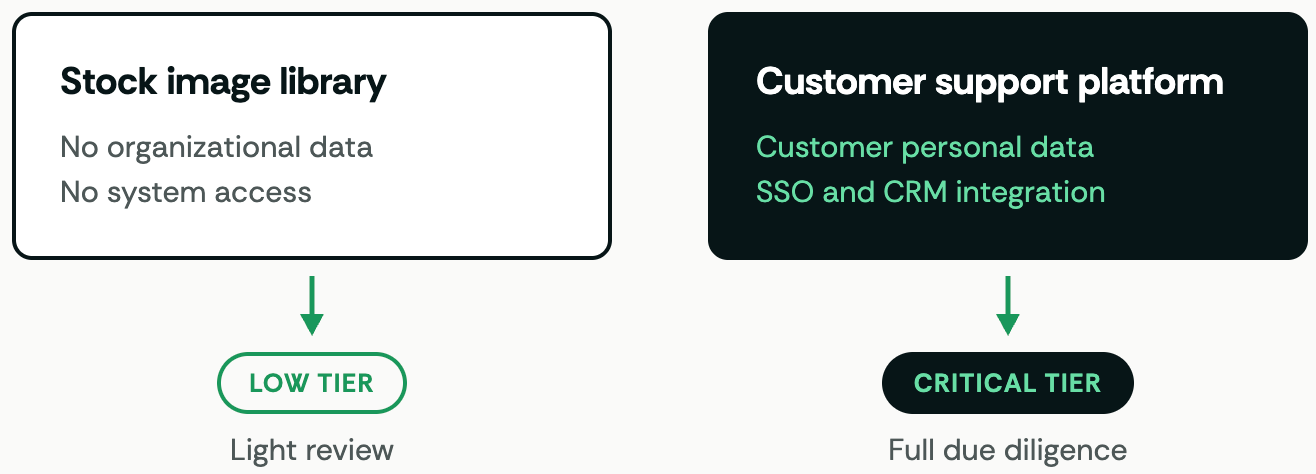
However, tiering can be unreliable when it depends primarily on business owners' subjective judgments or commercial factors like contract value. A low-cost vendor may still hold broad OAuth permissions, process sensitive customer data, or connect to production systems. Also, risk changes as vendor capabilities, usage patterns, security posture, and regulatory obligations evolve, making an initial classification insufficient on its own. A defensible model considers data sensitivity, connected-system criticality, regulatory exposure, operational dependency, and the availability of alternatives if the vendor becomes unavailable.
Lema's approach to tiering distinguishes between the period before a vendor is connected to the organization's environment and the period after. Before connection, the platform independently analyzes its capabilities, data-handling practices, and integration footprint to establish an initial view of inherent risk. Then, once real usage data becomes available through blast radius monitoring, it updates that view to reflect what the vendor is actually doing in the environment.
For AI vendors specifically, Lema's materials describe an additional classification of the solution type (an AI provider, an AI-native application, or a product with embedded AI) and of its capabilities, such as code execution or autonomous action, given that an agent acting on its own warrants controls that a read-only assistant does not.
Evidence-based due diligence
For many TPRM teams, the most visible operational problem is the assessment backlog. Due diligence, which evaluates whether a third party meets the organization's security, compliance, and operational standards, has long been conducted primarily through questionnaires: the vendor completes a spreadsheet, the TPRM team reviews the responses, and the vendor is either approved or flagged for follow-up. For critical vendors, this exchange can take weeks or months, and the TPRM function often becomes a procurement bottleneck, or business pressure forces the vendor into use before the review is complete, leaving security to catch up after access has already been granted.
The more fundamental limitation, however, concerns what the process actually produces. Questionnaire-based assessment generates compliance documentation rather than security evidence because responses are self-reported and rarely validated against external signals. A vendor may attest to holding a SOC 2 report whose scope does not cover the service the organization uses, or it may cite a clean penetration test that never examined the relevant application.
Evidence-based due diligence shifts the emphasis from collecting answers to verifying claims. In practice, this means analyzing the underlying artifacts, such as SOC 2 reports, penetration test results, privacy policies, and data processing agreements, and supplementing them with open-source intelligence drawn from trust center disclosures, publicly reported breaches, adverse media, M&A activity, and observable changes in the vendor's security organization. The objective is to surface contradictions between what the vendor states and what the evidence shows, then direct targeted follow-up questions only at the remaining gaps, keeping requests to the vendor short and specific.
Lema's Forensic AI Assessment is designed around this model. It cross-examines vendor artifacts against the organization's own control framework, identifies where stated controls diverge from the available evidence, and generates only the specific questions the vendor still needs to answer; Lema's documentation cites, for example, the discovery of an offshore subprocessor appearing on the OFAC sanctions list within an otherwise unremarkable set of artifacts. According to the company, an end-to-end assessment completes in under five minutes, and the output doubles as audit-ready evidence of due diligence mapped to frameworks like SOC 2, ISO 27001, and GDPR.
Blast radius mapping
As vendors become more deeply embedded in daily operations, the damage from a single vendor incident increasingly extends well beyond the vendor itself, whether that incident is an outage or a breach. In the case of an outage, the July 2024 CrowdStrike incident showed the scale involved: a faulty software update, rather than an attack, disrupted critical operations across a wide range of industries at once. Breaches follow a similar pattern, since an attacker who compromises a single vendor can often reach many of its downstream customers through the access that vendor already holds. In both cases, the consequence of a vendor incident is largely determined by how deeply that vendor is woven into the organizations that rely on it.
The same exposure also builds up across the vendor portfolio as a whole, in the form of concentration risk. Vendors that look unrelated on a register may depend on the same underlying provider, such as a cloud platform, an identity service, or a payment processor. The organization usually has no contract with these fourth parties and little visibility into them. A single failure at a shared dependency can therefore disrupt several vendors at once, a correlated failure that no individual vendor assessment would reveal. Some regulators now require organizations to account for this. The EU's Digital Operational Resilience Act (DORA), for example, requires financial entities to assess concentration risk in their ICT third-party arrangements.
A security rating or posture score therefore offers only partial information; it describes the vendor while revealing very little about what would happen inside a particular organization if that vendor were compromised. Blast radius mapping addresses the remaining half of the picture. For each vendor, it traces the systems the vendor connects to, the data it can reach, the teams that depend on it, and the operational, financial, and regulatory consequences of a breach, outage, or failure.
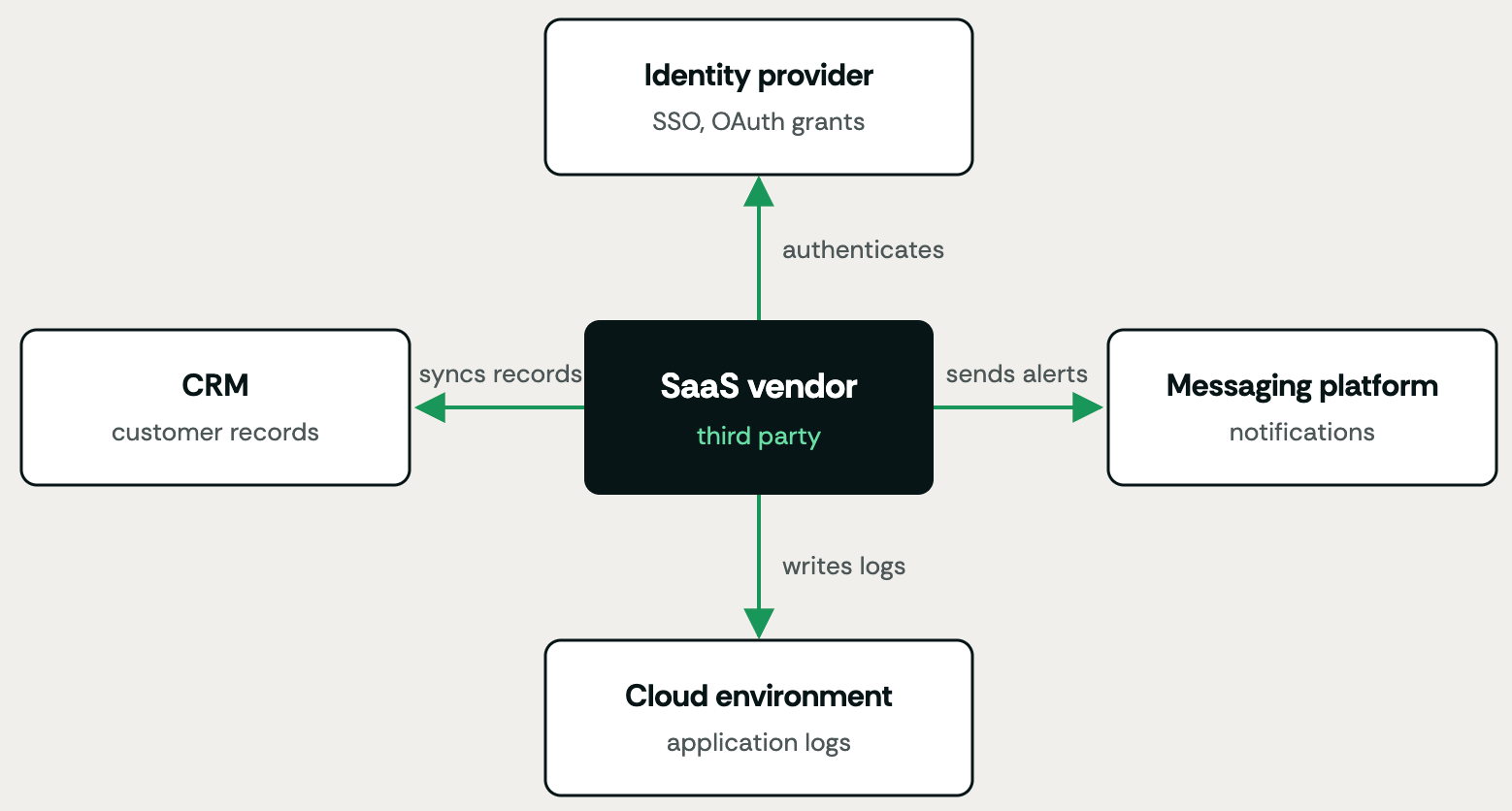
Vendor integrations are seldom simple, so this mapping cannot rely on the documentation produced at contract signing. A single SaaS product might authenticate through an identity provider, synchronize records with a CRM, push notifications through a messaging platform, and write logs to a cloud environment. Each of those connections represents a path a threat actor may attempt to exploit or compromise.
Accordingly, an accurate map reflects the interface as it exists today, including current permissions, active data flows, connected systems, and the extent of access relative to what was originally approved. Without it, a vendor rated "medium risk" on posture alone might in fact carry severe organizational impact, and the organization would have no way of knowing.
Because vendor interfaces change, the map is most useful when maintained as a living artifact that evolves with the relationship. Lema's Blast Radius Monitoring integrates with the identity, CASB, and EDR layers of the organization's stack to maintain this view continuously, tracking permissions, data flows, and connected systems for each vendor and estimating the potential impact of a failure across critical assets.
{{banner-small-1="/inline-cards"}}
Continuous discovery and monitoring
Periodic review cycles assume that the vendor inventory and each vendor's risk profile remain broadly stable between assessments, although neither assumption holds for long. New third parties enter the environment after the inventory is compiled, and vendors already on record change through restructuring, acquisitions, new features, and expanding permissions. Continuous discovery and monitoring therefore replace the annual calendar with event-driven reassessment, in which each material change opens a workflow with an owner and a defined response.
On the discovery side, the inventory built in the first stage must keep pace with third parties that arrive through channels seldom routed through procurement, such as OAuth grants, browser and IDE extensions, API keys, and MCP servers connected to AI agents. Known vendors can also change character, for instance when a product with no AI capability at onboarding adds AI features or begins sending data to a new model provider. Treat each occurrence as a discovery event that returns the third party to tiering and assessment.
Monitoring, for its part, follows how vendors already in the inventory evolve, including scope drift, namely the gradual expansion of token permissions, data sharing, and integrations beyond what was approved. It combines external intelligence, such as disclosed breaches, leadership changes, and adverse media, with internal telemetry on permissions, data flows, and usage, much of which comes from the same identity, CASB, and EDR integrations that support discovery. A separate exposure arises when vendor employees paste customer data into unsanctioned AI tools, often under consumer terms that permit retention or model training. Unclear to internal monitoring systems, this activity must be tracked through contractual and disclosed signals, such as the vendor's AI acceptable-use policy, its list of AI subprocessors, and contractual limits on processing customer data in unapproved AI services.
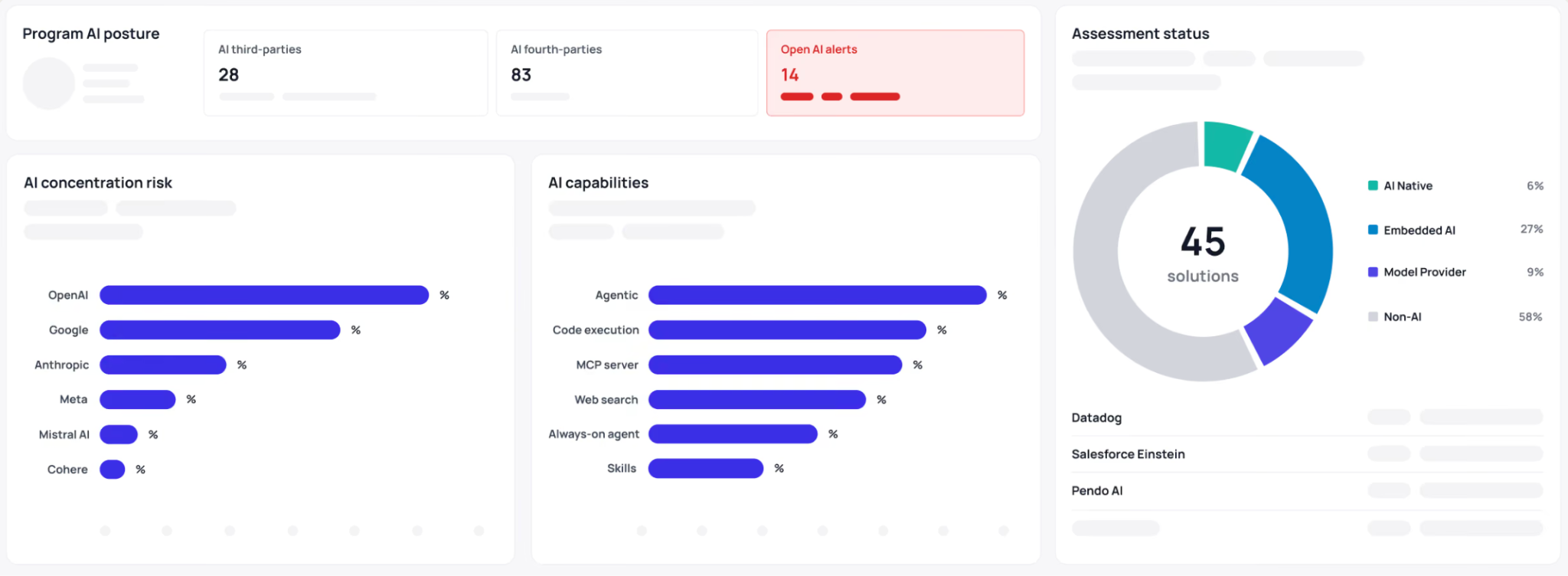
Lema's platform joins discovery and monitoring in a single continuous loop, so a new vendor, a permission grant, a reported breach, or detected scope drift automatically returns the affected vendor to discovery and assessment. Its Third-Party AI Governance capability applies the same approach to AI, surfacing unsanctioned AI across SaaS applications, OAuth apps, extensions, APIs, and MCP servers, and detecting AI capabilities that vendors add after their assessment. Any such material change reopens the assessment for the vendor concerned.
Risk remediation and closure
Risk remediation translates assessment findings into actions that reduce an organization's exposure to a vendor. Depending on the finding, this may involve changing internal configurations, revoking excessive permissions, restricting access, or requiring the vendor to address a control gap. A TPRM program's effectiveness depends not only on identifying risks but also on ensuring that findings are resolved, accepted through a formal risk decision, or otherwise managed appropriately.
Remediation often stalls when findings enter a shared queue without a clear owner or distinction between actions the organization can take itself and those that require vendor cooperation. Internal issues, including excessive OAuth permissions or unnecessary production access, may remain unresolved while teams wait for external responses. Vendor-dependent actions, like providing an updated penetration test or evidence of multi-factor authentication (MFA), can also remain open without defined deadlines and escalation paths. This can leave significant exposure unaddressed, even when the underlying issue is well understood.
A more effective process routes findings into separate internal and vendor-facing remediation workflows, each with assigned owners, timelines, and escalation criteria. Internal actions can range from revoking excessive permissions through the identity provider to restricting access to non-production environments, reducing unnecessary data exposure, or blocking unauthorized access through endpoint and network controls.
Vendor-facing actions may include requesting updated security evidence, requiring credential rotation, or seeking remediation of a control deficiency. When immediate remediation isn't possible, organizations should document the risk, assign an accountable owner, and determine whether compensating controls, formal risk acceptance, or restrictions on the vendor are necessary.
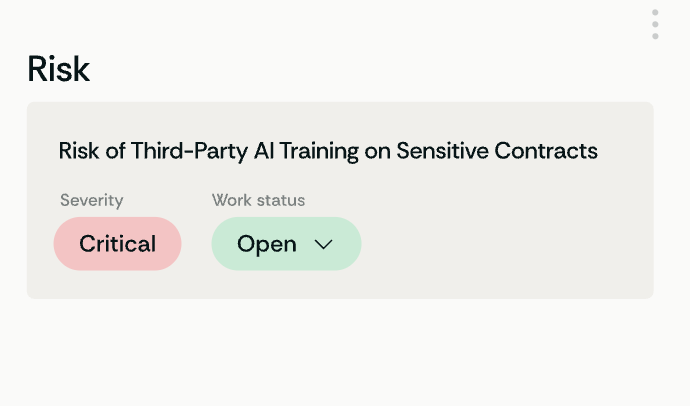
Lema's agentic risk engineering layer converges findings from artifact analysis, open-source intelligence, and blast radius monitoring into a prioritized set of material risks ranked by business impact. Each finding is assigned to an accountable owner, whether a business owner or the security or identity team, and includes a specific closure action, along with the context and reasoning behind it. When an internal fix is available, it is presented alongside any vendor-facing request so the immediate exposure can be reduced while the vendor-dependent item proceeds through its own escalation path.
Vendor offboarding
Vendor offboarding closes a third-party relationship and removes or accounts for the access, integrations, and data associated with it. A complete process includes revoking credentials, OAuth grants, API keys, and other access paths; disconnecting integrations; and confirming that organizational data has been returned or deleted in accordance with contractual requirements. This includes addressing data held by subprocessors and retained in backups where applicable. The organization should also update its vendor inventory, document outstanding obligations, and retain evidence of completed offboarding.
The circumstances under which a relationship ends shape how offboarding is triggered. Some relationships end deliberately through termination, non-renewal, or replacement. Others end without any formal decision. For example, a team may stop using a tool, or the business owner who sponsored it may leave the organization with no one taking over as its point of contact. In either case, neither procurement nor security is informed.
These stale vendors present the more difficult case, because no offboarding workflow is ever initiated and the vendor drops out of active use while remaining connected, holding standing access that is no longer monitored, reviewed, or justified. An unused integration with valid credentials is, in effect, exposure without corresponding business value, as a compromise at that vendor can still reach the organization's systems and data through tokens no one is actively monitoring.
Data retention adds another complication because a vendor may continue to hold organizational data under its own retention policies or pass it to subprocessors even after access has been revoked.
Treating offboarding as a defined stage, with its own checklist and owner, addresses the deliberate case. Every planned termination should initiate a workflow covering access revocation, integration removal, attestation of data return or deletion, and contractual close-out. Stale vendors, by contrast, can only be identified through the same internal telemetry used for discovery and blast radius mapping, since identity provider logs, CASB data, and integration activity reveal when access remains active even after usage has stopped. A sustained decline in usage should therefore flag the vendor for review, after which the organization either confirms that the relationship is still needed or begins offboarding.
Lema's Blast Radius Monitoring identifies stale vendors, defined as inactive vendors that still hold the access and integrations granted at onboarding. It routes the unused access through the internal remediation path used for other findings. Completing offboarding updates the inventory and reduces the overall blast radius, returning accurate information to the earlier stages of the loop.
{{banner-small-3="/inline-cards"}}
Conclusion
Each stage of the TPRM process depends on the one before it, and a gap at any point carries forward into every stage that follows. The practical takeaway is that these seven stages work best not as a linear checklist reviewed once a year, but as a continuous loop where discovery, assessment, monitoring, and remediation feed back into one another as conditions change. Getting this loop right is what separates a TPRM process that documents risk from one that actually reduces it.